
1. What Is Solder Paste?
Solder paste is a homogeneous, thixotropic mixture of microscopic metal solder alloy powder suspended in a viscous flux medium.
Solder paste contains two essential elements:
- Solder alloy powder, which becomes the metallic connection.
- Flux medium, which supports deposition, helps remove oxides, and protects surfaces during heating.
Manufacturers offer different combinations of alloy, powder size, and flux chemistry for specific deposition and assembly requirements.
2. How Does Solder Paste Work?
Solder paste performs different functions during printing, placement, heating, and cooling.
Deposition
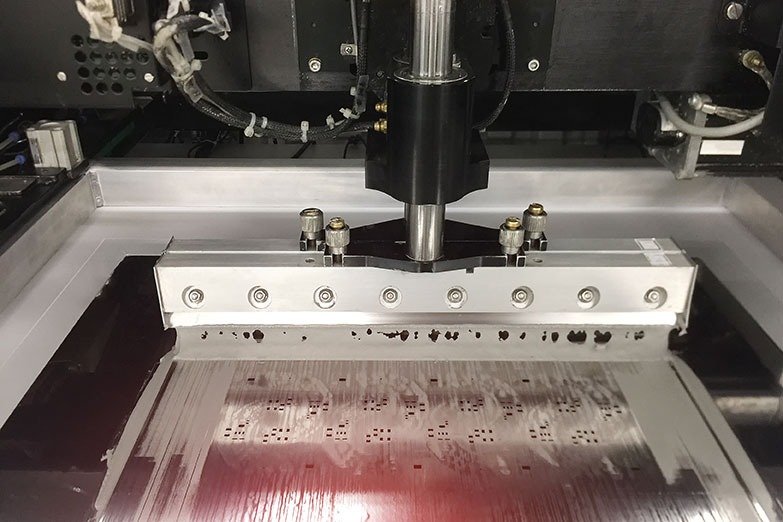
A stencil printer, dispenser, or compatible jetting system places paste at the intended connections.
Component Placement
The paste’s tack helps retain components before reflow. Placement must provide appropriate contact without excessively spreading the deposit.
Heating and Reflow
As the assembly heats, the flux system conditions the joining surfaces and helps limit oxidation. The solder particles melt and coalesce, wetting suitable pads and component terminations.
The profile must suit the alloy, flux, components, and board. An oven setpoint is not a substitute for a measured assembly profile.
Cooling
The molten solder solidifies into the joint. Flux residue may remain, depending on the formulation and cleaning procedure.
Printed paste volume is not the same as final solder-metal volume. The flux medium does not become solid solder. This distinction matters particularly when calculating deposits for large joints or through-hole connections.
3. Main Types of Solder Paste
Solder paste should be classified along several independent dimensions. A powder classification does not identify the alloy, and a “no-clean” label does not describe particle size.
| Classification | Common Examples | Main Selection Question |
|---|---|---|
| Alloy system | Tin-lead, tin-silver-copper, and application-specific lower-temperature alloys | Does the alloy meet assembly, service, and project requirements? |
| Flux system | No-clean, water-soluble, and rosin-based formulations | Can the residues remain, or must they be removed? |
| Powder classification | Type 3, Type 4, Type 5, and finer grades | Can the paste deposit reliably through the intended geometry? |
| Deposition method | Stencil printing, dispensing, or jetting | Is the formulation approved for the selected equipment? |
Alloy Selection
Choose the alloy according to component compatibility, thermal limits, joint requirements, and applicable customer specifications.
A lower melting temperature may reduce processing demands, but it does not automatically produce equivalent mechanical or service performance. Assess the actual alloy and application.
Flux Selection
No-clean formulations are intended for applications where qualified residues may remain. Whether cleaning can be omitted still depends on the actual assembly and requirements.
Water-soluble formulations require an appropriate cleaning process according to the product instructions. Do not assume every such residue can be left indefinitely before cleaning.
Rosin-based products also require review of their specific classification and cleaning requirements. These categories are broad descriptions rather than complete acceptance criteria.
Powder Size
Higher powder type numbers generally indicate finer particle classifications. Finer powder can support smaller deposition features, but the correct choice depends on the aperture, formulation, and process.
4. PCB and Stencil Design Considerations
Solder paste performance depends on the relationship between the PCB footprint, solder mask, stencil aperture, and component termination.
These features should be reviewed together before production.
Pad Geometry
Start with the component manufacturer’s recommended land pattern and the assembler’s approved design rules.
Pads must support the required connection while accounting for fabrication tolerances and component variation. Avoid enlarging pads simply to obtain more solder without checking spacing, wetting balance, and neighboring features.
Solder Mask Openings
Solder mask defines exposed areas; the stencil defines paste deposition. The mask opening and paste aperture therefore do not have to match each other or the copper pad exactly.
Review mask registration and separation between adjacent pads. Unintended exposed copper can change where molten solder flows.
Stencil Thickness and Apertures
For an idealized stencil opening: Vaperture=Aapertures×Tstencil
However, the actual deposited volume also depends on transfer efficiency. Increasing stencil thickness may increase theoretical volume while making small apertures harder to print consistently.
Area Ratio and Paste Release
The stencil area ratio compares the opening area with its wall area:Area Ratio=Aperture Opening Area/Aperture Wall Area
For a rectangular aperture with length L, width W, and stencil thickness Area Ratio = LW/2t(L+W)
A lower ratio generally makes release more demanding. The practical limit depends on the stencil, paste, surface finish, and printing process; it should not be treated as one universal number.
Thermal Pads and Vias
Follow package-specific recommendations for exposed pads. Segmented apertures may be appropriate, but their geometry and coverage require validation.
Open vias can divert solder from the intended connection. Specify their treatment and review how they affect deposition, outgassing, and the finished joint.
5. Pin Solder Paste (Pin-in-Paste / Intrusive Reflow) Technology
Pin in paste (also known as Pin-in-Paste or Intrusive Reflow Solder Technology) is an innovative manufacturing method that eliminates the need for a secondary wave soldering or manual soldering step for through-hole components.
- How It Works: Through-hole pads are designed with extra-large paste volume capacity. Solder paste is dispensed or stencil-printed directly over and into the plated through-holes (PTH). Through-hole component leads are then inserted into the wet paste, and the entire board undergoes standard surface-mount reflow.
- The Reflow Mechanism: During thermal profiling, the paste melts, and capillary action draws the liquid solder down into the barrel, achieving complete vertical fill without a solder wave machine.
- Key Advantages:
- Combines SMT and THT production into a single reflow oven pass.
- Eliminates capital expenditure and maintenance associated with dedicated wave soldering equipment.
- Reduces thermal shock on delicate components by processing the entire board in a controlled, gradual reflow profile.
6. Best Practices for Storing and Handling Solder Paste
Because solder paste is a chemically active and temperature-sensitive compound, strict handling protocols are mandatory:
- Refrigeration: Store unopened jars or cartridges in a dedicated refrigerator maintained at 0℃ to 10℃ to prevent flux separation and alloy oxidation.
- Thawing Procedure: Remove paste from refrigeration at least 4 to 24 hours before use. Never open a cold jar immediately; letting it reach ambient room temperature naturally prevents moisture condensation from forming on the paste.
- Mixing and Kneading: Stir mechanically (or via automated planetary mixers) for the manufacturer-specified duration to restore ideal thixotropic viscosity before loading onto the printer.
7. Frequently Asked Questions
Is Solder Paste the Same as Flux?
No. Solder paste contains solder alloy powder and flux. Flux alone generally requires a separate source of solder metal.
Is Finer Powder Always Better?
No. Select powder size with the deposition geometry, formulation, equipment, and required process stability.
Can All Through-Hole Components Use Pin-in-Paste?
No. The component must be approved for reflow, and the design must accommodate adequate paste deposition and acceptable finished connections.
Can the Paste Layer Match the Copper Pads Exactly?
Sometimes, but not automatically. Aperture geometry should reflect the package, stencil thickness, paste release, and required solder volume.
Does No-Clean Paste Mean No Further Evaluation Is Needed?
No. Confirm that residues and the actual process meet the product requirements, including any cleaning, testing, coating, or bonding operations.
 Russian
 English
 German
 French
 Spanish
 Vietnamese