
1.Locating Pins Overview
locating pins core function : to determine and restrict the position and orientation of a part relative to other parts.
The “how to pin location” here is mechanical, not digital. It’s about establishing a physical pin location meaning that guarantees precise positioning every single time. This is critical for pcb locating pins where the correct alignment of a pcb pin header or other pcb pins can dictate the functionality of the entire electronic device.
2. Essential Types of Locating Pins & Their Design Principles
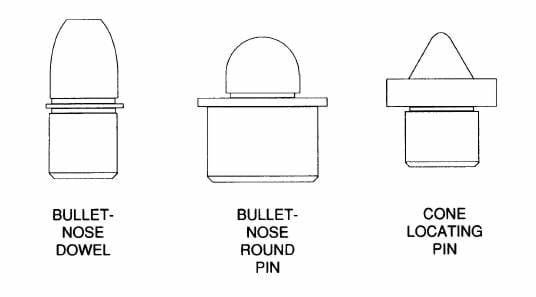
locating pins come in diverse forms, each optimized for specific alignment challenges. Understanding these types of locating pins is key to selecting the right solution.
2.1. Round Locating Pins (Standard Locating Pin)
- Design: These are cylindrical pins, often ground to a precise diameter. They typically work in conjunction with a corresponding round hole in the workpiece or fixture.
- Function: A single round locating pin restricts two degrees of freedom (X and Y translation) but allows rotation. When used with a second diamond locating pin, they fully define the position.
- Applications: General-purpose positioning for most machining and assembly operations. An indispensable locating pin for pcb setups where multiple pins are used to secure the board.
2.2. Diamond Locating Pins
- Design: A diamond locating pin (also known as a relieved or conical locator) has two opposing sides relieved or tapered, giving its cross-section a diamond shape.
- Function: This ingenious design is crucial for resolving over-constraint issues. While a round pin defines X and Y, the diamond pin defines only one axis (e.g., X), allowing for slight variations in the distance between the two locator holes (e.g., Y-axis floating), thereby preventing binding. This is often the locating pin design of choice when paired with a round pin.
- Applications: Essential for accurately pin a location when two or more pins are used on a workpiece with tight tolerances, compensating for slight dimensional inaccuracies or thermal expansion. Widely used in locating pins for fixtures in multi-station setups.
2.3. Oval/Relieved Locating Pins
- Design: Similar to a diamond pin, but with a more oval or elongated relief on two sides.
- Function: Provides freedom in one direction, accommodating variations in hole spacing without jamming.
- Applications: Often used as an alternative to diamond pins, offering similar benefits in preventing over-constraint.
2.4. Tapered Locating Pins
- Design: Features a tapered end that gradually increases in diameter.
- Function: Facilitates easier insertion and removal, especially when alignment is not perfectly precise initially. The taper guides the workpiece into the correct pin location.
- Applications: Quick changeovers, heavy workpieces, or situations where minor misalignments are expected during loading.
2.5. Threaded Locating Pins
- Design: A threaded locating pin has a threaded body allowing it to be screwed into a fixture or base plate, providing secure and adjustable mounting.
- Function: Offers a robust and reusable mounting method, making installation and replacement straightforward. The threaded locating pin ensures the pin itself is firmly anchored.
- Applications: Permanent or semi-permanent fixtures, quick-change tooling, and setups requiring precise height adjustment.
2.6. Ball Locating Pins
- Design: Features a spherical or ball-shaped head, often spring-loaded.
- Function: Provides omni-directional contact, minimizing wear and offering greater flexibility in accommodating slight angular misalignments. The spring-loaded nature allows for consistent clamping force.
- Applications: Indexing, quick-release mechanisms, and applications where smooth, low-friction contact is desired.
3. Applications
Locating pins are fundamental across virtually every manufacturing sector:
3.1. Electronics Manufacturing (PCB Locating Pins)
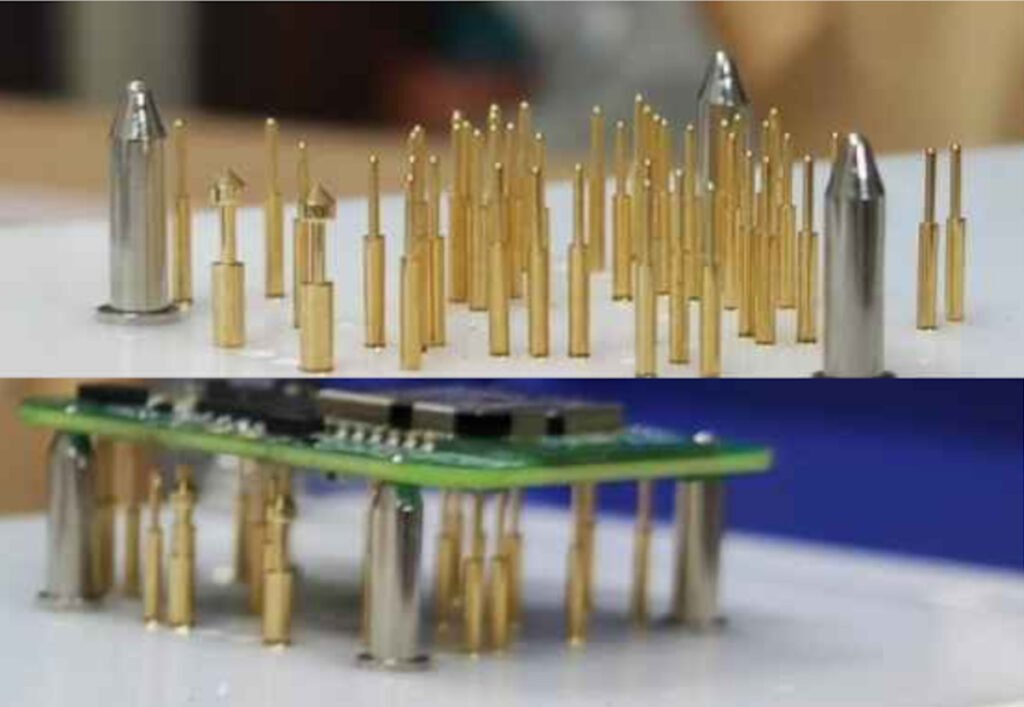
- PCB Fabrication: Locating pcb boards on drilling, routing, and testing fixtures. Precise locating pin for pcb ensures that tooling holes align perfectly with machine instructions. Without them, drilling errors or miscut board outlines would be rampant.
- Assembly: Positioning components or sub-assemblies onto a PCB pin header or other mounting points. PCB locating pins are crucial for consistent placement before soldering.
- Testing: Securing PCBs onto automated test fixtures (ATE), ensuring that test probes make accurate contact with the designated pcb pins.
3.2. Machining and Fixturing (Locating Pins for Fixtures)
- CNC Machining: Holding raw material blanks in vices or custom fixtures. The locating pins and bushings define the part’s zero point, ensuring consistent cutting paths.
- Welding and Assembly: Precisely positioning parts before joining. Locating pins for fixtures prevent movement during welding or bolting, ensuring dimensional accuracy of the final assembly.
3.3. Automotive and Aerospace
- Body-in-White Assembly: Aligning large stamped metal panels before robotic welding.
- Engine Component Manufacturing: Ensuring precision during multi-stage machining processes.
- Tooling: Locating pins are integral to jigs, fixtures, and gauges that verify component dimensions.
4. Locating Pin Design
Effective use of locating pins requires careful consideration of several factors:
- Tolerance Stack-up: The combined tolerances of the pin, hole, and workpiece must be analyzed to ensure the pin’s effectiveness without causing binding. This is where a diamond locating pin shines.
- Material Selection: Hardened steel (for durability), stainless steel (for corrosion resistance), or even ceramics (for extreme wear resistance) are common choices.
- Surface Finish: Pins are often precision ground and polished to minimize friction and wear.
- Wear and Replacement: Locating pins are wear items. Regular inspection and timely replacement are crucial to maintain precision. A reliable locating pin supplier or locating pin manufacturer should offer high-quality, repeatable components.
- Clamping Strategy: Pins locate, but clamps hold. A proper clamping mechanism ensures the workpiece remains firmly seated against the locating pins during operation.
Effective locating pin design follows the classic 3-2-1 locating principle:
- One pin fully constrains two axes
- One secondary pin (often diamond) constrains one axis
- Remaining axes are left free
This method ensures precise pin location without over-constraining the part.
5. From Pin Drop to Precision: The Future of Alignment
While digital methods for “how to pin a location” are common in navigation (think pin drop location on maps or “how to drop a location pin” on your phone), the physical world of manufacturing continues to rely on robust mechanical solutions. The evolution of locating pins continues with advancements in materials, coatings, and integrated sensor technologies for monitoring wear and ensuring optimal performance.
For companies like Welleltron, providing high-quality locating pin solutions – from standard round pins to specialized diamond locating pin designs – is about empowering manufacturers to achieve higher precision, reduce scrap, and ultimately deliver superior products. Ensuring that every pin location is perfect is the foundation of quality.
Guide Pin Product

Carlson pin for PCB silk screen alignment
$0.1 – $1 / pcsExposure Pin for PCB Field
$1 – $0.2 / pcsPCB Silk Screen Copper Pin
$0.2 – $1 / pcsPress pin for PCB mould punching block remove
$0.1 – $1 / pieceRouting pin positioning pin for PCB
$0.1 – $1 / pcs


 German
  English
  French
  Spanish
  Vietnamese
  Russian