
What is a Flying Probe Testing (FPT)?
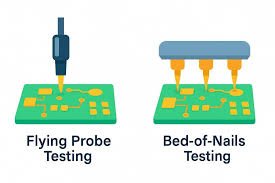
Flying Probe Tester (also called flying probes or a flying prober)is an advanced method of automated PCB testing,that utilizes high-speed, independently moving probes to contact test points on a circuit board. Unlike the traditional bed of nails test, which requires a custom-built jig testing fixture and thousands of bed of nails test pins, the flying probe machine uses software-driven arms to navigate the X-Y-Z axes.This eliminates the need for bed of nails test pins, reducing setup time and tooling cost.
Common testing modes include:
- Flying probe in circuit test
- PCB flying probe test
- Flying probe test PCB
- Flying probe PCB tester operations for assembled and bare boards
Technical Capabilities: ICT and Beyond
A modern flying probe tester is more than just a continuity checker. It performs a comprehensive flying probe electrical test, including:
- Flying Probe In Circuit Test (ICT): It measures resistance, capacitance, inductance, and diode/transistor characteristics to identify assembly defects.
- FCT Testing (Functional Testing): Many systems can power up the board and perform functional checks.
- Optical Inspection: High-end flying probe testers often include cameras to verify component orientation and polarity.
When comparing flying probe vs. ict (traditional fixture-based ICT), the flying prober wins on setup speed, while the bed of nails wins on speed test (cycle time) for mass production.
Top Flying Probe Tester Manufacturers
If you are in the market for flying probe test equipment, several industry leaders dominate the landscape, each offering unique strengths:
- Takaya Flying Probe: Widely considered the pioneer of the technology, a Takaya flying probe machine is known for extreme precision and reliability.
- Spea Flying Probe: Italian-made Spea flying probe tester systems are famous for their high-speed throughput and “multi-mode” testing capabilities.
- Seica Flying Probe: Known for versatility, Seica systems are often used for both testing and laser repairs.
- Acculogic & ATG: Acculogic flying probe systems are popular in North America, while ATG flying probe equipment is a staple for bare-board pcb flying probe test requirements.
- Hioki: The Hioki flying probe tester is highly regarded in the Asian market for its high-speed bare-board isolation testing.
Advantages of Flying Probe Test
Here are the primary advantages of using a flying probe tester for your PCB assembly:
1. No Fixture Costs (Fixtureless Testing)
The most significant advantage is the elimination of the custom test fixture.
- Cost Savings: Traditional ICT requires a bed of nails test fixture that can cost thousands of dollars per board design. FPT is software-driven, meaning no physical jig is built.
- Zero Lead Time: Since there is no hardware to manufacture, testing can begin as soon as the CAD data and the first board are available.
2. Ideal for Prototypes and NPI (New Product Introduction)
Because FPT requires only a software program change to adapt to a new design, it is the perfect solution for:
- Design Iterations: If a trace moves or a component changes during development, you simply update the program rather than re-drilling a test fixture.
- Low-Volume Production: For small batches, the cost of an ICT fixture is impossible to amortize, making the flying probe machine the only economical choice.
3. High Precision for High-Density Boards
As PCBs shrink, test pads become too small or too close together for standard bed of nails test pins.
- Small Target Access: Flying probes can accurately hit test points as small as 50-100 microns.
- High Pin Count: It can test boards with thousands of nets that would be physically impossible to “pin” with a traditional mechanical jig.
4. Comprehensive Electrical Testing
A modern flying probe electrical test performs more than just simple continuity checks:
- Analog & Digital ICT: It measures resistance, capacitance, inductance, and checks for open/short circuits.
- Power-on Testing: Many systems (like those from Takaya, Spea, or Seica) can apply power to the board to perform functional tests.
- Optical Inspection: Many testers include built-in cameras to check for component presence, polarity, and orientation simultaneously.
5. Non-Invasive and Safe
- Lower Mechanical Stress: A bed of nails applies massive pressure across the entire board, which can lead to board warping or solder joint cracks. Flying probes apply minimal, controlled pressure on individual points.
- Accessibility: Probes can reach components on both the top and bottom of the board (on dual-sided systems) without needing a complex double-sided fixture.
Comparison at a Glance
| Feature | Flying Probe (FPT) | Bed of Nails (ICT) |
| Upfront Cost | Very Low (Software only) | High (Custom hardware) |
| Setup Time | Hours | Weeks |
| Test Speed | Slower (Probes must move) | Very Fast (Parallel testing) |
| Best For | Prototypes / Small Batches | Mass Production |
| Flexibility | Extreme | Poor |
Flying Probe Tester Price and Cost Considerations
The flying probe tester price depends on:
- Number of probes
- Test speed and accuracy
- Software capabilities
- Inline vs standalone systems
Compared to bed of nails test, the total cost of ownership is often lower for low-to-medium volume production.
Conclusion
For Welleltron PCB Consumables Supplier, offer flying probe tester is a powerful, flexible solution for modern automated PCB testing. From Flying Probe Test (FPT) to advanced pcb flying probe tester systems, this technology bridges the gap between prototype validation and mass production.
 German
  English
  French
  Spanish
  Vietnamese
  Russian