
A PCB mounting mold—also called a metallographic mounting cup or microsection mounting mold—holds the specimen and mounting resin while the mount forms. The resulting block makes small PCB coupons easier to handle during grinding and polishing.
Match the Mold Size to Your Grinding Equipment
Your mold dimensions must seamlessly fit your laboratory’s automated grinding and polishing machine chucks . Mismatched sizes cause clamping slip, angular distortion, and ruined samples.
- Standard Diameter Hierarchy:
25 mm (1.0 in): Best for single PTH barrels, fine-pitch BGA pads, and individual microvia coupons.30 mm (1.25 in): The global manufacturing baseline for multi-layer PCB cross-sections.40 mm (1.5 in): Tailored for heavy copper power planes, thick backplanes, and large PCBA modules.
- The Aspect Ratio Rule: Maintain a puck height-to-diameter ratio between 1:1 and 1:1.5. Excessively tall resin pucks wobble under automated torque, while overly thin pucks fracture under mechanical clamping pressure.
Consider Mounting Method (Cold vs. Hot)
The mounting technique dictates the thermal and mechanical stress your PCB sample will endure during encapsulation.
| Mounting Method | Primary Resin Types | Compatible Mold Types | Best Suited For |
| Cold Mounting | Liquid Epoxy, Acrylic, Polyester | Silicone, PTFE rings, PE cups | Standard PCB microsectioning. Protects delicate multi-layer structures and heat-sensitive components from thermal degradation. |
| Hot Mounting | Thermoplastic Powders (Phenolic, Diallyl Phthalate) | Heavy Steel / Metal Compression Dies | Raw material laminates and rigid metal-backed boards. Offers rapid 5-minute cycles but applies extreme heat (150℃) and hydraulic pressure that can warp delicate circuit boards. |
Mold Material Selection
The body material of the mold dictates extraction ease, chemical resistance, and edge retention performance.
- Silicone Rubber (Silicone Cups):
- Characteristics: Highly flexible, naturally non-stick, and elastic.
- Advantage: Allows manual physical inversion to pop out cured pucks instantly without chemical release sprays, keeping resin margins pristine.
- PTFE (Teflon Rings):
- Characteristics: Chemically inert, rigid, and dimensionally stable.
- Advantage: Produces ultra-flat, parallel walls, making it the top choice for high-precision edge-retention analysis and IPC Class 3 compliance.
- Polyethylene (PE) / Polypropylene (PP):
- Characteristics: Semi-rigid, economical, and disposable.
- Advantage: Ideal for high-volume, cost-sensitive daily production lines where molds can be discarded after a single use.
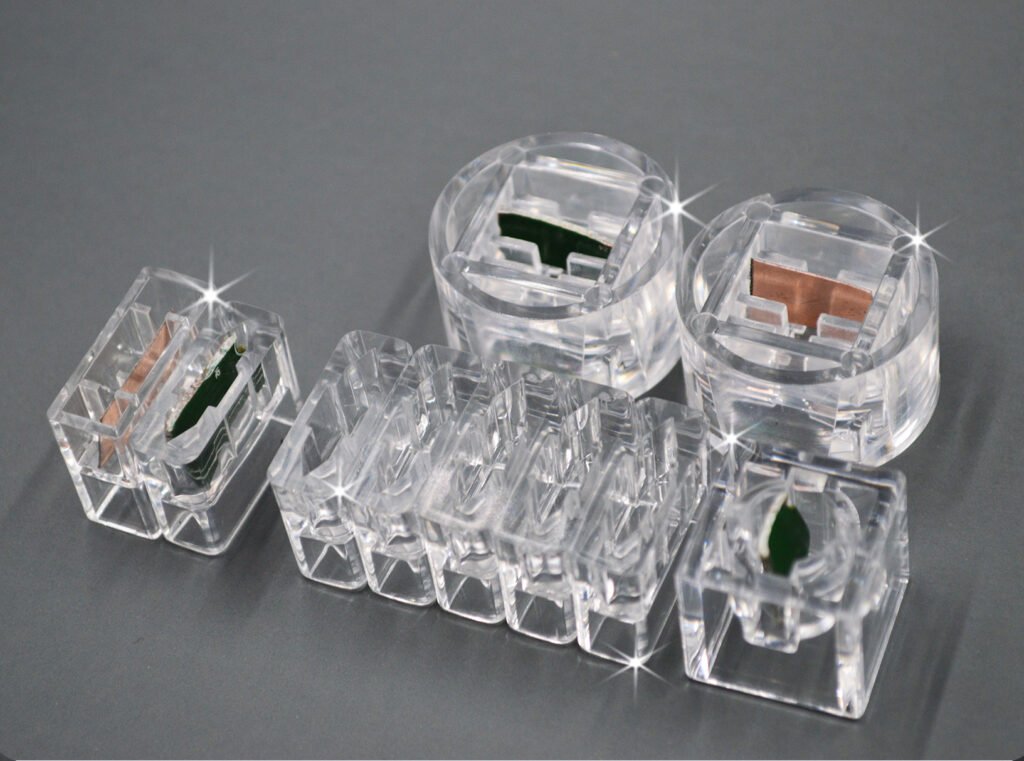
Demolding Mechanism Comparison
A suitable demolding mechanism should release the fully cured mount without damaging it or permanently deforming the mold. For PCB microsectioning mold, compare release effort, cleaning requirements, and dimensional consistency using the actual mounting resin. Easy release during the first cycle does not establish long-term suitability.
| Demolding mechanism | How it works | Main advantage | What to check |
|---|---|---|---|
| Flexible-wall mold | The walls flex or peel away from the cured mount | Simple manual release with few separate parts | Resin compatibility, loss of flexibility, and distortion after repeated use |
| Removable-base cup | The base is detached to provide access for releasing the mount | Convenient access for demolding and cleaning | Base sealing, resin leakage, and whether removal requires excessive force |
| Split mold | The mold separates around the cured mount | Reduces the need to push the mount through a fixed opening | Joint alignment, sealing, and flash that may interfere with clamping |
| Disposable cup | The cup is removed or discarded according to its design | Eliminates repeated mold cleaning | Ease of removal, consumable cost, and compatibility with curing conditions |
| Hot-mounting press ejection | The press ejects the mount from its mold assembly after the specified cycle | Integrates release into the mounting process | Equipment-specific ejection procedure, cooling requirements, and tooling condition |
For reusable cold-mounting molds, conduct several trial cycles and record removal time, mold wear, and finished mount dimensions. If release becomes difficult, check curing completion, resin compatibility, and residue before applying more force. Use release agents only as directed by the supplier, keeping them away from the PCB specimen where resin adhesion is required. Clean specimen surfaces help the resin bond effectively.
Check Resin Compatibility and Inspection Requirements
1.Resin Chemistries & Mold Compatibility Matrix
Choosing the right resin requires balancing curing time, exothermic behavior, and chemical aggression against the mounting mold material.
| Resin Type | Curing & Thermal Profile | Compatible Mold Materials | Key Engineering Considerations |
| Liquid Epoxy | Low exotherm, slow cure (4–8 hours) | Silicone, PTFE (Teflon), PE | Industry standard for electronics. Offers ultra-low shrinkage and excellent adhesion, preventing interfacial gaps between the resin and copper walls. Requires vacuum degassing. |
| Acrylic Resin | High exotherm (>90℃), rapid cure (10–15 mins) | PTFE, High-Temperature Silicone | Generates significant heat during polymerization. Must use molds that resist thermal softening to prevent permanent sticking or mold deformation. |
| Polyester Resin | Moderate cure speed, distinct chemical odor | PTFE, PE | Requires chemically inert molds to prevent the aggressive solvent base from bonding permanently to the mold walls. |
2. Critical Encapsulation Parameters
- Exotherm Control & Thermal Degradation: For multi-layer boards containing sensitive dielectric materials or low-Tg laminates, high-exotherm acrylics can cause localized thermal stress or resin-glass delamination. Slow-curing epoxies are preferred for high-reliability Class 3 assemblies.
- Vacuum Impregnation (Degassing): Trapped air bubbles inside plated-through-holes (PTH) or blind microvias lead to false porosity readings or copper tearing during polishing. Encapsulated samples must undergo vacuum extraction immediately after pouring the liquid resin.
- Interfacial Adhesion: Poorly cleaned or oxidized PCB coupons prevent proper resin wetting, resulting in “pull-away” gaps where polishing abrasives become trapped, causing rounded edges and distorted copper thickness measurements.
3. Microsection Inspection Requirements & Standards
Once the mounted sample is cured, ground, and polished, it must pass rigorous inspection criteria before data is recorded or reported.
- IPC Standards Compliance:
- IPC-TM-650 (Method 2.1.1): Governs standard manual and automated microsection preparation procedures, ensuring repeatable and reliable cross-section quality.
- IPC-6012 / IPC-A-600: Establishes acceptance criteria for inner-layer connection integrity, barrel copper thickness (minimum 20μm for Class 3), foil roughness, and dielectric spacing.
- Visual & Microscopic Inspection Checklist:
- Edge Retention: The interface between the copper trace/plating and the mounting resin must remain sharp, with zero rounding or smearing.
- No Plating Smears or Pull-Outs: Verify that structural anomalies (such as cracks, voids in solder joints, or barrel plating thinning) are genuine material defects rather than mechanical damage induced during sample preparation.
- Clean Polishing Finish: The cross-section must be free from deep micro-scratches, etchant staining, or embedded diamond grit that could obscure micro-structure analysis.
Frequently Asked Questions
What is the best mold size for PCB microsectioning?
The best size fits the grinding and polishing holder and accommodates the specimen arrangement with adequate resin support. Check finished height and dimensional tolerance as well as nominal diameter.
Is cold mounting always better than hot mounting for PCBs?
No. The choice depends on specimen sensitivity and the inspection objective. Cold mounting is useful when applied heat and pressure are concerns; hot mounting requires validation that its conditions will not alter the features being examined.
Can silicone molds be used with epoxy resin?
Some products can, but compatibility and service life depend on the specific mold and epoxy system. Obtain product-specific confirmation.
Does a PCB mounting mold need to be “IPC certified”?
Ask what any such claim covers. The mold should support the specified preparation procedure; a product label alone does not demonstrate that the finished microsection meets the inspection requirements.
Is a transparent mold necessary?
Transparency can help operators see positioning or filling, but it is not the only selection factor. Check whether visibility is needed through the mold during mounting or through the cured resin during target preparation.
 German
 English
 French
 Spanish
 Vietnamese
 Russian