
Hitachi Thickness Gauges Overview
Hitachi Thickness Gauges (incorporating the legacy of Oxford Instruments) offers a world-class portfolio of Coating Measurement Instruments (CMI). These gauges are designed to provide non-destructive, high-precision thickness data across a wide range of industrial applications, particularly in the PCB (Printed Circuit Board), semiconductor, and electroplating sectors.
Core Product Series
Handheld Thickness Gauges
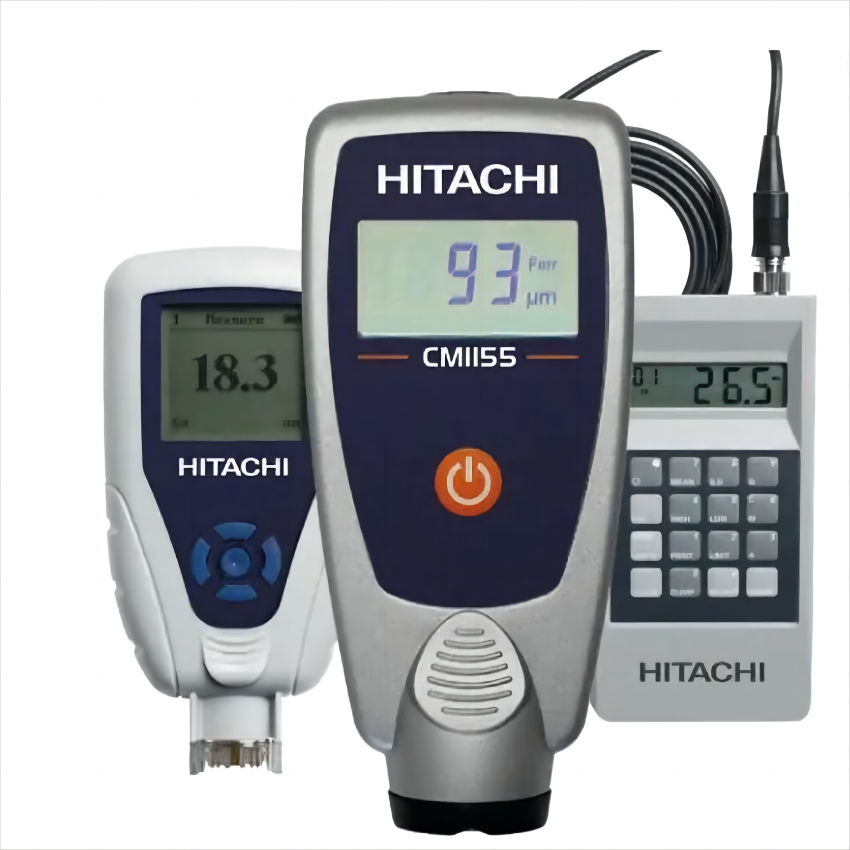
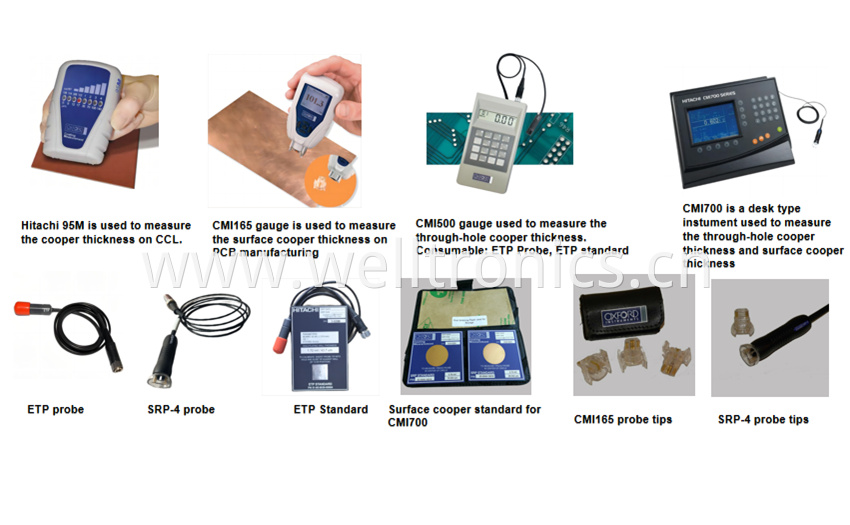
CMI 165: The industry’s “go-to” handheld thickness gauge for surface copper. It is rugged, portable, and uses the patented SRP-4 probe.
CMI 243: A versatile digital thickness gauge that handles both ferrous and non-ferrous applications, popular in general metal finishing.
Benchtop & Modular Systems
- CMI 500/700 Series: These are modular thickness measurement instruments used in laboratories. You can connect different probes to a single base unit to switch between measuring copper foil, through-hole plating, or metallic coatings.
- CMI 900 Series: High-end XRF systems for automated, high-speed plating thickness analysis.
Key Technology Pillars
Hitachi gauges stand out because they utilize specialized physical principles tailored to specific material combinations:
X-ray Fluorescence (XRF): For ultra-thin, precious metal plating (Gold, Palladium, Silver) where sub-micron accuracy is required.
Micro-resistance (MR): Used exclusively for measuring copper foil on PCBs. It uses a four-point probe to measure electrical resistance, ensuring that the thickness reading is not skewed by copper layers on the opposite side of the board.
Eddy Current: Ideal for measuring non-conductive coatings (like paint or lacquer) on non-ferrous metal substrates (like aluminum) or thin conductive coatings on non-conductive bases.
Magnetic Induction: The standard for measuring non-magnetic coatings (zinc, chrome, or paint) on magnetic substrates like steel.
The Critical Role of Calibration Standards
Every Thickness Gauges tool is only as accurate as its last calibration. Using a Calibration Standard is non-negotiable in precision manufacturing.
Hitachi provides NIST-traceable foils and shims that serve as the reference for the thickness unit being measured. For example, when measuring standard pcb board thickness, you must calibrate your gauge meter digital using a foil that closely matches your target range (e.g., 35μm$ for 1oz copper).
Welleltron provides these essential thickness gauges accessories to ensure your coating thickness measuring instrument remains within factory specifications, preventing “measurement drift” that can lead to entire batches of boards being scrapped.
Hitachi Advantages
- NIST Traceability: Every Hitachi Calibration Standard is traceable to international standards, ensuring your QC data passes any audit (Apple, Tesla, Boeing, etc.).
- Non-Destructive Testing (NDT): Measure coatings without scratching or damaging the final product.
- Operational Stability: Designed with high EMI shielding to work accurately even next to heavy machinery or plating tanks.
- Cost-Efficiency: Components like the SRP-4 probe have replaceable tips, drastically reducing long-term maintenance costs compared to “disposable” probes from other brands.
Applications Across Industries
1. Electronics & PCB Manufacturing
In this industry, precision is measured in microns (μm). Thickness gauges ensure that conductive layers are sufficient for electrical loads but thin enough for miniaturization.
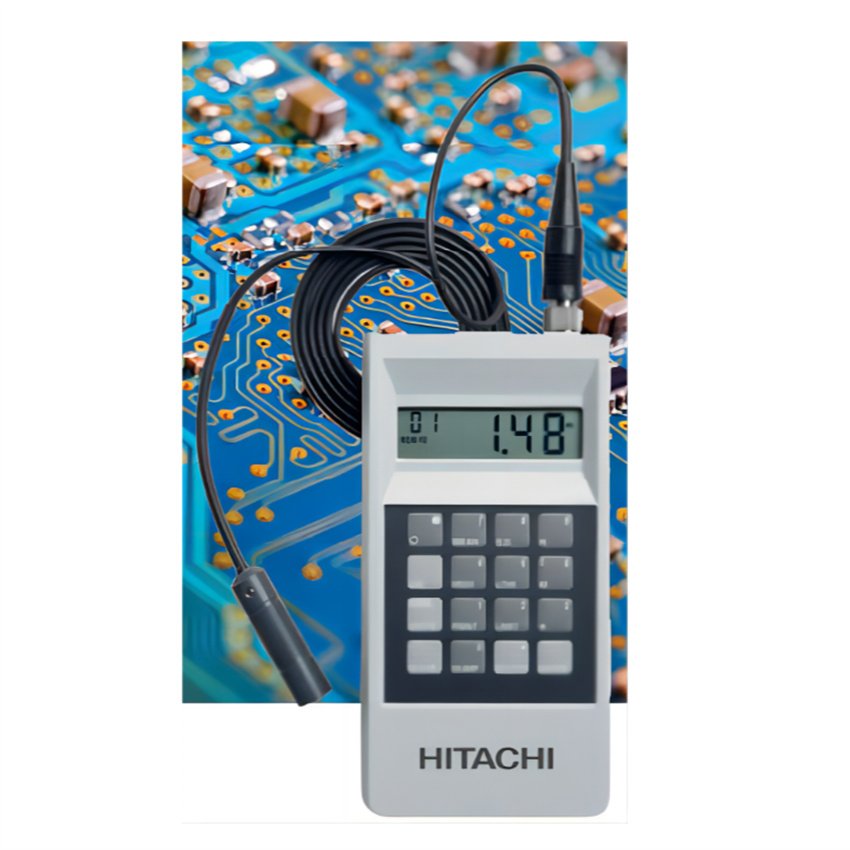
- Copper Foil Measurement: Using micro-resistance gauges (like the Hitachi CMI 165) to measure the surface copper on PCB laminates.
- Plating Thickness: Measuring Gold, Nickel, or Tin plating over copper pads to ensure solderability and prevent oxidation.
- Dielectric/Core Thickness: Ensuring the standard PCB thickness (e.g., 1.6 mm) is maintained for structural integrity and fit within enclosures.
2. Automotive Industry
The automotive sector relies on thickness gauges for both safety and aesthetics.
- Paint & Powder Coating: Gauges are used to ensure paint thickness is uniform across the vehicle body. Too thin, and the metal may rust; too thick, and the paint may crack or waste resources.
- Brake Disc & Tire Tread: Specialized digital gauge meters measure the wear on brake rotors and tire treads to determine when parts need replacement.
- Airbag Covers: Precise measurement of the “score lines” on airbag covers ensures they will deploy correctly during an impact.
3. Aerospace & Defense
In aerospace, material fatigue and weight are critical factors.
- Turbine Blade Coatings: Measuring Thermal Barrier Coatings (TBC) on engine parts that must withstand extreme heat.
- Skin Thickness: Ultrasonic thickness gauges are used to check for internal corrosion or “thinning” of the aircraft’s aluminum skin without tearing the plane apart.
- Composite Materials: Measuring the thickness of carbon fiber layers used in modern fuselage construction.
4. Packaging & Plastics
Consistency in packaging ensures product freshness and reduces plastic waste.
- Film Extrusion: Continuous measurement of plastic films (like cling wrap or industrial liners) to ensure they meet strength specifications.
- Bottle Wall Thickness: Measuring the base and walls of PET bottles to ensure they can withstand carbonation pressure without bursting.
Summary of Common Measurement Technologies
| Technology | Best For… | Industry Example |
| Magnetic Induction | Non-magnetic coatings on steel. | Automotive Paint |
| Eddy Current | Non-conductive coatings on non-ferrous metal. | Anodized Aluminum |
| Micro-resistance | Conductive coatings on conductive bases. | PCB Copper Foil |
| Ultrasonic | Measuring thickness when only one side is accessible. | Oil Pipelines |
| X-Ray Fluorescence | Ultra-thin precious metal layers. | Semiconductor Plating |
Beyond Thickness: Coating Hardness and Surface Prep
While measuring thickness is vital, it is often paired with other tests. A coating hardness tester is frequently used alongside a coating Thickness Gauges to ensure that a protective layer is not only the right depth but also sufficiently cured to withstand mechanical wear.
Furthermore, the accuracy of your thickness tool depends on the cleanliness of the surface. At Welleltron, we recommend using sticky rollers to remove micro-dust from the PCB surface before using your digital Thickness Gauges. Even a few microns of dust can throw off a thickness gauge meter reading, leading to false negatives in your QC report.
Global Standards and GEO-Compliance
Whether you are a manufacturer in the tech hubs of Shenzhen, the automotive corridors of Germany, or the aerospace clusters in the United States, adhering to standard pcb board thickness (such as the common 1.6 mm or 0.062inches) is a global requirement.
Hitachi coating thickness measuring equipment is designed to meet international standards including IPC, ASTM, and ISO. By using a thickness measurement instrument that is recognized globally, Welleltron’s clients ensure their products are ready for export to any market.
Conclusion
Hitachi Thickness Gauges represent a comprehensive portfolio of advanced thickness measurement equipment, covering magnetic, XRF, optical, and ultrasonic technologies. From coating thickness measurement instruments to PCB and material thickness analysis, Hitachi solutions deliver accuracy, reliability, and long-term value。From providing the latest Hitachi CMI units to supplying the Calibration Standard foils and pcb locating pins needed for a seamless production line, Welleltron is dedicated to your precision.
 Vietnamese
  English
  German
  French
  Spanish
  Russian