
1. What Are Ringed and Ringless PCB Drill Bits?
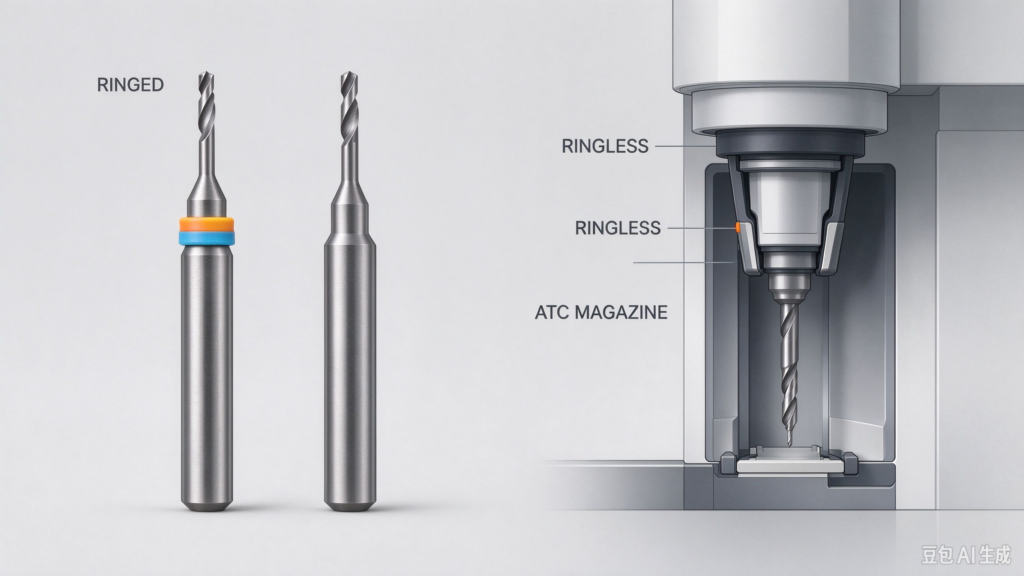
A ringed PCB drill bit has a collar fitted around its shank at a specified axial position. Depending on the equipment design, the ring provides a locating reference or interacts with the tool-storage and handling arrangement.
A ringless PCB drill bit is supplied without that collar. Its suitability depends on how the machine stores, transfers, seats, and measures the tool.
The ring does not replace:
- The spindle collet’s clamping function.
- The drill’s cutting geometry.
- The machine’s depth settings or tool-length verification.
- Inspection of the tool’s condition and dimensions.
A correctly positioned ring cannot compensate for a worn collet, bent shank, or unsuitable drill.
2. ringed vs ringless PCB drill bits Differences
| Feature / Parameter | Ringed PCB Drill Bits | Ringless PCB Drill Bits |
| Physical Structure | Fitted with a precision plastic or brass stop ring pressed onto the shank at a fixed distance. | Smooth, uninterrupted cylindrical carbide shank from butt end to cutting flute transition. |
| Z-Axis Depth Registration | Mechanical Stop: The ring rests directly against the spindle collet nose or tool cassette edge. | Sensor / Collet Stop: Relies on internal collet stops, optical depth sensors, or laser tool-setting systems. |
| ATC Gripper Interaction | Gripper fingers clamp below or around the ring; prevents axial slipping during high-speed transfer. | Gripper fingers clamp directly onto the smooth carbide surface; requires high friction and exact jaw tension. |
| Regrinding Flexibility | Limited: Regrinding alters overall length; the ring must be stripped and re-pressed to restore Z-height. | High: Simply regrind the tip and let the CNC laser/touch sensor automatically compensate for the new length. |
Neither format is inherently more accurate or longer-lasting. Cutting performance depends on the complete drill design, material, operating conditions, and holding system. Compare ringed vs ringless drill bits formats primarily as a compatibility question.
3.PCB Drill Bit Locating Ring vs. Depth Setting Ring
A PCB drill bit locating ring is also commonly described as a PCB drill bit depth setting ring. In an arrangement designed to seat against the ring, its specified position establishes a repeatable relationship between the drill tip and the seating reference.
However, “depth setting” does not mean the ring directly controls the depth of every drilled hole. Actual penetration also depends on the machine’s tool reference, programmed motion, workpiece position, and drilling setup.
Before accepting a ringed drill, confirm:
- Which ring face defines the reference.
- The specified distance from that face to the drill tip.
- Ring dimensions, setting tolerance, and condition.
- Whether the tool meets the machine’s seating and engagement requirements.
The ring positions the tool where the equipment design requires it; the spindle collet provides the clamping force during cutting.
4.Laser Tool Setting vs Mechanical Ring: Different Functions
When comparing laser tool setting vs mechanical ring positioning, first distinguish measurement from mechanical location.
A mechanical ring provides a physical reference in a compatible loading arrangement. A laser tool-setting system measures the tool without contact; depending on its capabilities and installed measurement cycles, it may determine tool length or radius and check for breakage.
The two approaches can work together:
- Mechanical ring: Helps establish the intended loading position where the machine uses that reference.
- Laser tool setting: Measures or verifies the loaded tool within the supported measurement range.
- Combined arrangement: Uses mechanical positioning followed by measurement or monitoring.
A laser-equipped machine does not automatically accept ringless drills. The magazine or gripper may still require the ring. Conversely, a ringed tool may still require length measurement or breakage detection.
5. How to Check ATC compatibility Before Ordering
Treat the drill, magazine, gripper, and spindle as one connected system. A tool may fit one interface while failing at another.
| Interface | Information to Verify |
|---|---|
| Machine configuration | Model, tooling option, and approved ringed or ringless format |
| Spindle and collet | Shank diameter, tolerance, engagement, and tool projection requirements |
| Tool pod or cassette | Seating geometry, tool orientation, and ring clearance where applicable |
| Tool gripper | Intended gripping location and compatible tool configuration |
| Tool-length or presence detection | Supported tool range, reference method, and required setup |
| Drill specification | Cutting diameter, flute length, overall length, and ring details |
Before approving a substitution:
- Obtain the machine’s tooling specification.
- Identify the current approved drill part number and configuration.
- Compare the new tool drawing with the required interfaces.
- Resolve differences with the tool supplier or equipment service provider.
- Validate the replacement through the prescribed tool-change and drilling checks.
A previously used tool is useful as a reference, but its current dimensions may have changed through wear, resharpening, or ring movement. Use approved specifications wherever available.

6. Can Rings Be Added, Removed, or Reset?
Only where the tool design and equipment procedure permit it. Adding or removing a collar is not, by itself, a validated conversion between tooling systems.
If ring installation or resetting is permitted, confirm:
- The correct ring and its compatibility with the shank.
- The setting dimension, datum, and tolerance.
- The specified setting equipment and inspection method.
- Whether the ring may be reused.
- How the tool is protected from damage during the operation.
After resharpening, the tip position may change. A ring that has not moved on the shank may therefore no longer meet the specified ring-to-tip relationship. Inspect and reset it only according to the applicable service procedure.
7. Tool Change Failure: Where Should You Look First?
A pickup or release failure is not automatically a ring problem. Identify the failed stage before changing the drill or replacing an ATC component.
| Symptom | Tool-Related Checks | Associated System Checks |
|---|---|---|
| Tool sits too high or low in the magazine | Ring position, overall length, loading orientation | Pod reference, debris, damage, or incorrect magazine configuration |
| Gripper fails to pick up the tool | Correct tool format and presentation | Gripper alignment, condition, actuation, and position detection |
| Tool will not seat in the spindle | Shank size, contamination, damage, or interference | Collet condition and clamp/release operation |
| Tool projection varies after changes | Ring setting, tool length, and seating | Collet engagement, loading repeatability, and measurement system |
| Tool-length alarm follows a substitution | Actual dimensions and ring configuration | Programmed limits and the approved detection setup |
| Problem begins after resharpening | Revised tip position and service condition | Updated tool reference and required verification |
Use the machine’s approved maintenance and diagnostic procedures. Do not bypass alarms or continue repeated automatic cycles when a tool is incorrectly seated.
8. FAQ
Do all automatic tool changers require ringed drill bit?
No. The required format depends on the specific magazine, handling, positioning, and spindle arrangement. Confirm the machine’s tooling specification.
Can ringless drill bits be used in a system designed for ringed tools?
Do not substitute them without approval. Missing the required ring may affect seating, presentation, or the tool-length reference.
Does a ringed drill produce more accurate holes?
Not automatically. A ring can support repeatable positioning in a compatible system, but hole quality also depends on the drill, spindle, collet, material, and process.
Is the same ring position suitable for every PCB machine?
No. Confirm the dimension, reference face, and tolerance for the actual equipment. A supplier’s standard setting is not proof of universal compatibility.
Are all 3.175 mm shank ringed drill bits interchangeable?
No. Overall length, ring dimensions and position, tool geometry, and loading requirements must also match.