
Overview of Diameter, Shank, Coating, and Flute Length
I. Micro drill bit Four Core Parameters Selection Benchmark Table
Before selecting a PCB micro drill bit, define these four specifications. Together, they establish the required hole size, tool-holding compatibility, cutting-surface specification, and usable flute length.
| Core Dimension | Standard Available Range / Specifications | Engineering Selection Core Rules | Key Quality Control Thresholds |
| 1. Diameter | 0.05 mm – 6.50 mm • Micro-vias: 0.15 mm • Fine pitch: 0.15 – 0.30mm • Standard holes: >0.30 mm | Determined by the target finished hole size and board stack thickness (aspect ratio). | Radial runout must be strictly controlled to ≤0.003 mm (for drills <0.20 mm). |
| 2. Shank | 3.175mm (1/8inch) (Global industry standard; specialized ultra-micro drills utilize reinforced stepped shanks) | Must perfectly match CNC drilling machine (Schmoll.)spindle collets and ATC tool grippers. | Shank tolerance: +0.000 / -0.005 mm; must distinguish between “Ringed” and “Ringless” configurations. |
| 3. Coating | • Uncoated • DLC (Diamond-Like Carbon) • PVD / TiN / AlTiN Nano-Coatings | Selected based on substrate abrasiveness and resin properties (PVD for highly abrasive glass/ceramic fillers; DLC for tacky resins). | Coating thickness must be controlled at 0.5 – 1.5μm to preserve original cutting edge sharpness. |
| 4. Flute Length | 0.8 mm – 55.0 mm (Micro-drills typically range from 8 to 12diameter) | Must cover total stack thickness plus backing/entry board clearance, while strictly avoiding excess length. | Torsional rigidity decreases significantly with every 10% increase in flute length; prioritize web taper designs. |
1. Start with the Application and Hole Requirement
Before comparing drill specifications, define what the tool must produce and under which conditions.
Collect four groups of information:
- PCB material: Laminate grade, reinforcement, fillers, copper construction, and relevant material characteristics.
- Hole requirement: Plated or non-plated, through-hole or another approved application, finished diameter, and tolerance.
- Drilling arrangement: Board thickness, number of boards per stack, entry material, backup material, and required penetration.
- Equipment: Machine and spindle model, collet specification, tool-loading arrangement, and available inspection capability.
“Micro drill” is a product description, not a complete application specification. Supplier product families differ in their diameter ranges, geometry, and intended materials.

Cutting Diameter: Match the Manufacturing Hole
Cutting diameter and finished-hole diameter are not always the same. For plated holes, copper deposited on the hole wall reduces the opening. The drill size must therefore follow the fabricator’s approved allowance and process—not simply the finished diameter printed on the drawing.
| Specification | Meaning | Selection Check |
|---|---|---|
| Cutting diameter | Nominal diameter of the drill’s cutting portion | Match the approved drilling requirement |
| Diameter tolerance | Permitted variation in the tool diameter | Confirm suitability for the process capability |
| As-drilled hole diameter | Hole size after drilling, before subsequent processing | Inspect using the specified method |
| Finished-hole diameter | Hole size at the required final inspection stage | Account for plating and other relevant process effects |
When selecting the diameter:
- Confirm whether the drawing specifies finished or drilled dimensions.
- Separate plated-through-hole requirements from non-plated-hole requirements.
- Check the supplier’s actual size increments and diameter tolerance.
- Include tool condition, runout, and measurement uncertainty in process evaluation.
Do not use a universal oversize allowance for all plated holes. A drill with the correct nominal diameter still requires validation against the actual hole result.
Shank Diameter: Confirm Holding and Tool-Change Compatibility
The shank is the portion held by the spindle collet. It can be much larger than the cutting diameter, particularly on small PCB Micro drill bit.
Match the specified shank diameter and tolerance to the approved collet. Do not treat similar nominal sizes as interchangeable without confirmation.
Check the complete loading arrangement:
- Shank dimensions and condition: Correct diameter, clean surface, and no damage affecting seating.
- Overall length: Compatibility with the machine’s loading and tool-length requirements.
- Locating ring, where fitted: Correct position and configuration for the tool-change system.
- Insertion and projection: Compliance with the spindle and machine instructions.
- Holding performance: Acceptable retention and runout using the prescribed inspection method.
A locating ring does not replace the collet’s clamping function. Likewise, successful pickup by the tool gripper does not prove that the drill is correctly seated in the spindle.
Flute Length: Match the Drilling Stack Without Unnecessary Length
Flutes provide space for chip formation and evacuation. Their length must suit the actual drilling arrangement, but a longer flute is not automatically a better choice.
Review:
- The combined thickness of the boards being drilled.
- Entry material and the intended penetration into the backup material.
- Drill-point geometry and the supplier’s definition of usable drilling depth.
- Tool projection, clearance, and chip-evacuation requirements.
Flute length is not identical to overall length, and it should not automatically be treated as the maximum permissible drilling depth.
As a selection principle, use the shortest qualified geometry that provides the required reach and chip clearance. Unnecessary length can reduce resistance to deflection, while insufficient usable length can compromise clearance and evacuation.
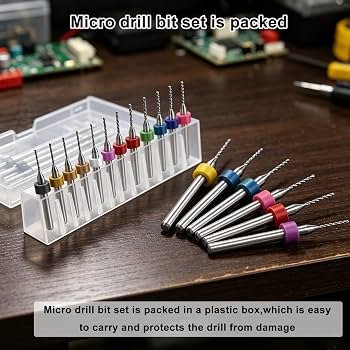
Coated vs. Uncoated PCB micro drill bit
A coating should be selected as part of a complete tool design. Its usefulness depends on the substrate, edge preparation, coating characteristics, workpiece, and cutting conditions.
| Selection Question | Uncoated Drill | Coated Drill |
|---|---|---|
| Has the tool been qualified for the material? | Confirm material and process suitability | Confirm the specific coating-and-geometry combination |
| What limits its service life? | Evaluate wear, breakage, and hole-quality trends | Check whether the coating addresses the observed limitation |
| What does it cost to use? | Compare accepted output and changeover costs | Verify that additional output offsets any price premium |
| Can it be resharpened? | Confirm the supplier’s service policy | Confirm how resharpening affects the coating and usable condition |
Ask the PCB micro drill bit supplier for:
- The coating designation and intended PCB applications.
- Evidence from comparable materials and tool sizes.
- Recommended operating conditions and quality endpoints.
- Inspection and resharpening requirements.
Do not identify a coating by color or assume a coating proven in steel machining is appropriate for FR-4 drilling. Avoid promising a fixed life multiplier without a controlled comparison.
Validate the Tool and Prepare a Clear Purchase Specification
Use a controlled trial before adopting a new drill design or coating.
- Record the setup: Tool reference, material, stack, entry and backup materials, spindle, and operating conditions.
- Inspect initial output: Check hole size, location, burrs, and other required characteristics.
- Track performance through use: Compare early, middle, and later tool-life stages.
- Assess internal quality where required: Use appropriate microsection inspection rather than relying only on the hole entrance.
- Define the replacement point: Base it on approved quality and service criteria, not only on whether the tool remains unbroken.
For cost comparisons, use accepted output under comparable conditions. The cheapest drill may not provide the lowest cost per acceptable hole, but a premium drill is not automatically more economical.
Frequently Asked Questions
Is a micro drill bit the same as a PCB drill bit?
Not necessarily. Micro drills are also made for metals and other materials. Select a tool explicitly suitable for the PCB laminate and drilling application.
Can I choose the drill diameter directly from the finished-hole dimension?
Not for every application. Plated holes require the approved drilling allowance. Confirm the manufacturing stage represented by the drawing dimension.
Does the same shank diameter mean two drills are interchangeable?
No. Overall length, ring position, geometry, usable depth, and application compatibility must also match.
Can two PCB micro drill bits with 1/8-inch shanks be interchanged?
Only after checking actual shank dimensions, cutting diameter, overall length, depth ring position, flute geometry, and installed tip position. Confirm fit and hole quality on the intended machine before approving a substitute.
Are coated PCB drills always better than uncoated drills?
No. Compare the complete tool under relevant conditions and use accepted hole quality, verified life, and cost to make the decision.