
A PCD Blade costs more per piece, a Tungsten Carbide Blade costs less. The real question is cost per cut, not blade price. On abrasive FR4 production running three shifts, PCD usually wins on cost per cut. On low-volume, mixed-board or prototyping lines, carbide often wins because you never amortise the higher PCD price.
1. What Is the Difference Between PCD and Carbide V-scoring blade?
Tungsten carbide V-scoring blade: solid carbide body, ground V edge, standard choice for most PCB depaneling machines. Can be re-sharpened several times by a local grinding shop.
PCD : carbide body with a polycrystalline diamond layer on the cutting edge. Extremely hard, very low wear against glass fibre and resin. Re-sharpening is limited or not possible depending on the tip construction.
Both cut a V-groove to a controlled residual thickness. The difference is how long the edge holds that geometry.
Before comparing quotations, confirm:
- Cutting material: PCD, tungsten carbide, or another specified material.
- Construction: Solid carbide, PCD-tipped, or another design.
- Geometry: Cutting angle, edge configuration, diameter, bore, and mounting interface.
- Application: Approved PCB materials, groove requirements, and machine compatibility.
A product described as a diamond V-cut blade is not automatically a PCD cutting blades. Diamond-coated tools and PCD-tipped tools have different constructions and should be identified separately.
2. PCD vs. Carbide: A Practical Comparison
| Comparison Point | PCD | Tungsten Carbide V-scoring blade |
|---|---|---|
| Initial purchase cost | Often higher; verify the actual quotation | Often lower; depends on size, grade, and geometry |
| Abrasive-wear resistance | A key reason to evaluate PCD for abrasive PCB materials | Grade-dependent; evaluate wear under the intended conditions |
| Potential service interval | May provide longer intervals where abrasive wear limits life | May be sufficient for the required volume and quality |
| Damage sensitivity | Edge chipping or impact damage can eliminate the expected life advantage | Also susceptible to chipping and damage; toughness depends on grade and geometry |
| Resharpening | Requires a service process suitable for the specific PCD tool | May be serviceable where the design and remaining dimensions permit |
| Economic priority | Demonstrate that additional usable output offsets the higher cost | Confirm that replacement and downtime do not outweigh the lower purchase price |
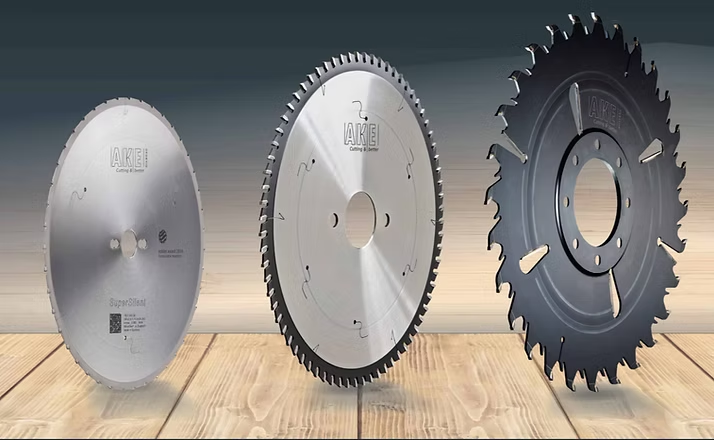
PCD tooling is used for abrasive materials, including glass-fiber materials, and PCB tool manufacturers offer PCD scoring saws for this application.
3. How to measure PCB V-scoring blade Life ?
Tool life should end at a defined quality or service limit—not only when the blade can no longer cut.
Agree on the endpoint before comparing PCD and carbide. Relevant checks may include:
- Burrs, edge chipping, and groove-surface condition.
- Groove geometry and remaining web thickness against the drawing.
- Blade wear or damage against the supplier’s service criteria.
- Adjustment frequency and the ability to maintain acceptable results.
Keep two life measurements separate:
- Life between services: Accepted output before removal for replacement or resharpening.
- Total service life: Accepted output accumulated across the new and approved resharpened stages until final retirement.
Panel count is useful only when panel designs are comparable. If one design contains twice the scoring length of another, “panels per blade” can be misleading. Record scoring length, panel thickness, groove configuration, and processing passes alongside accepted panel count.
There is no defensible universal claim that PCD lasts a fixed number of times longer than carbide without a defined test.
4. What Affects PCB scoring tool life Besides Cutting Material?
A material comparison is meaningful only when the surrounding process is understood.
PCB Material and Cutting Requirement
Record the laminate grade, reinforcement, fillers, thickness, and required groove geometry. Do not assume all FR-4 products create identical cutting conditions.
Machine and Installation
Check the mounting surfaces, blade seating, spindle condition, and runout using the specified procedure. Where opposing blades are used, verify their alignment and depth settings.
Operating Conditions
Use supplier-approved speed and feed ranges. Record actual settings, support conditions, and extraction performance. PCD and carbide do not necessarily achieve their best results at identical parameters.
Handling and Maintenance
Protect cutting edges during installation, storage, and shipment. Distinguish gradual wear from accidental chipping: a cutting blades removed after a collision does not represent its normal wear life.
A higher-grade cutting material cannot correct an unstable setup, unsuitable groove specification, or damaged mounting interface.
5. How to Calculate Cost per Accepted Panel
Purchase price alone does not show the cost of using a blade. A practical comparison is:
Cost per accepted panel = Total attributable tooling and scoring-loss cost ÷ Accepted panels produced
The numerator can include:
- Blade purchase cost.
- Approved resharpening and related freight.
- Blade-change, setup, and verification labor.
- Relevant downtime cost.
- Scrap or rework attributable to the scoring operation.
Use the same accounting boundary for both options. If blades operate as a pair, compare the cost and output of the pair rather than comparing one blade with a complete set. Avoid counting the same labor or downtime cost twice.
Illustrative Cost Example
The figures below are hypothetical calculation inputs—not market prices, product specifications, or measured PCD performance. Each option represents a complete comparable blade set used on the same panel design, with no resharpening included.
| Cost Item | Carbide Set | PCD Set |
|---|---|---|
| Purchase cost | $200 | $800 |
| Allocated change/setup cost | $100 | $100 |
| Attributable scrap/rework cost | $100 | $100 |
| Total cost | $400 | $1,000 |
| Accepted panels | 10,000 | 40,000 |
| Cost per accepted panel | $0.040 | $0.025 |
6. Which v groove cutting blade Should You Choose?
Evaluate PCD First When:
- Repeated production provides enough volume to use its potential life.
- Records show that abrasive wear drives blade replacement.
- Changeovers or quality drift create a measurable cost.
- Equipment condition and handling are controlled.
- Suitable technical support and blade servicing are available.
Keep Carbide in the Comparison When:
- Production volume is low or specifications change frequently.
- Its verified life already meets the job requirement.
- Lower initial expenditure matters more than extending a service interval.
- Actual cost per accepted panel is competitive.
- Trials have not demonstrated a sufficient benefit from PCD.
For a useful Blade Supplier inquiry, provide the machine model, blade drawing, laminate type, board thickness, scoring layout, groove requirements, current blade history, and observed defects.
7. Frequently Asked Questions
Does PCD always last longer than tungsten carbide?
No. PCD may offer a wear-life advantage in a suitable abrasive application, but actual life depends on geometry, material, setup, handling, and the quality endpoint. Premature damage can remove that advantage.
Is PCD always cheaper per panel?
No. It becomes economical only when accepted output and other savings offset its additional costs. Low utilization or short achieved life can favor carbide.
Can PCD and carbide blades use the same settings?
Do not assume so. Confirm suitable settings with the tool and machine suppliers. Compare both options against the same finished-groove requirements while documenting any parameter differences.
What is the fastest way to PCB V-Scoring Cutter cost?
Measure V-groove depth properly and stop replacing blades early. Many factories change blades on a fixed schedule and throw away usable life.
Can I replace a carbide blade with a PCB V-scoring blade on the same machine?
Only if the cutter matches the machine and the job. Verify the outside diameter, bore, blade thickness, mounting pattern and required scoring angle against the blade drawing