
1. How to Choose PCB Router Bits
Before comparing cutters, define the machining task and its acceptance requirements.
- Board material: Identify the laminate grade, reinforcement, fillers, copper construction, and whether the board has a metal core.
- Geometry: Record slot widths, internal corner radii, contour details, and dimensional tolerances.
- Machining arrangement: Confirm board thickness, stack height, support, tool access, and entry method.
- Quality requirements: Define acceptable edge condition, dimensions, burrs, and relevant damage limits.
- Equipment: Identify the spindle, collet, tool-loading arrangement, and extraction system.
A PCB routing cutter or PCB milling cutter should be selected for the actual material and operation. Matching a generic tool description is not enough.Carbide PCB router bits are available in several geometries.
2. PCB Router Bit Diameter
Cutting diameter is the diameter of the cutting portion. It affects access to narrow features, internal corner geometry, tool stiffness, and the amount of material engaged during machining.
| Selection Factor | What to Check |
|---|---|
| Narrow slots and openings | Whether the cutter and toolpath can produce the required width and tolerance |
| Internal corners | Whether the specified radius can be produced with the selected diameter |
| Open contours | Whether a larger qualified tool can provide useful stiffness without restricting access |
| Actual machined dimensions | Tool diameter tolerance, wear, runout, deflection, and cutter compensation |
| Toolpath strategy | Full-width slotting, side cutting, roughing, and finishing requirements |
A smaller PCB router bit diameter can reach finer features, but it generally provides less resistance to deflection when other conditions are comparable. Conversely, a larger cutter may not fit the required geometry.
Select a diameter that satisfies the smallest necessary feature while providing adequate stability for the job. Do not assume that nominal cutter diameter alone determines the finished slot width.
3. Shank Diameter and Cutting Length
Shank diameter describes the portion held by the spindle collet. It is separate from cutting diameter.
A 3.175 mm shank router bit has a nominal 1/8-inch shank, but that does not establish its cutting diameter, usable cutting length, or compatibility with every PCB machine.
Verify:
- The specified shank diameter and tolerance against the approved collet.
- Overall length, locating-ring requirements, and automatic tool-change compatibility.
- Required collet engagement and permitted tool projection.
- Cutting length against the board or stack thickness and toolpath.
- Clearance between the non-cutting portion, workpiece, fixture, and support.
Flute length and usable cutting length may not be identical on every design. Follow the supplier’s drawing.
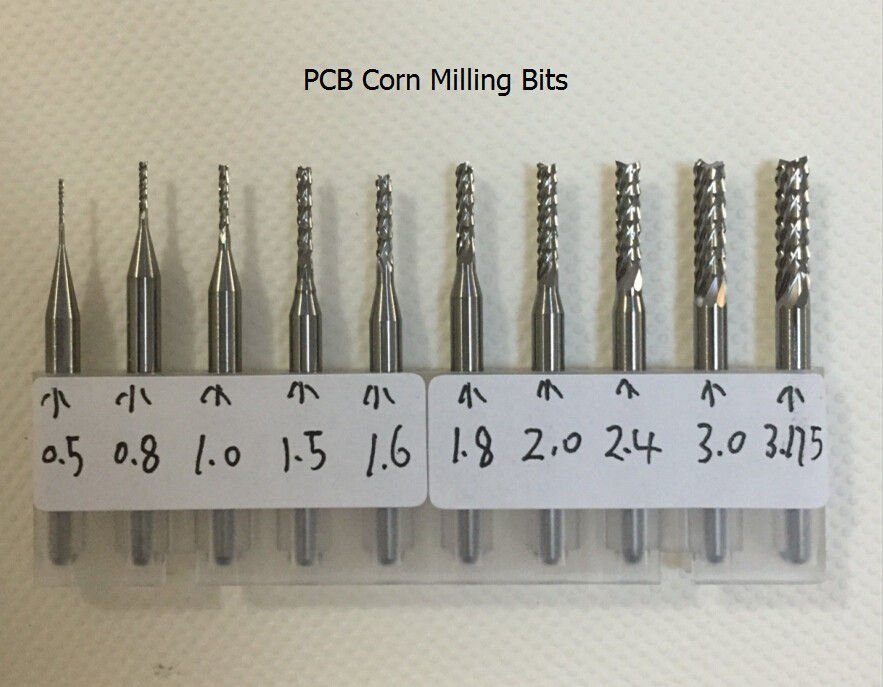
4. PCB Router Bit Flute Count and Cutting Geometry
PCB router bit flute count should be evaluated together with tooth pattern, helix direction, chip space, and cutting-edge design. More flutes do not automatically produce better PCB edges.
For conventional fluted end mills, flute count affects the number of cutting engagements and interacts with feed per tooth and available chip space. Cross-cut and diamond-cut PCB routers require attention to their specific geometry rather than a simple two-flute-versus-four-flute comparison.
| Cutter Geometry | Selection Focus |
|---|---|
| Spiral-flute design | Cutting action, chip space, helix direction, and application suitability |
| Chipbreaker design | How the interrupted cutting geometry manages debris and cutting load |
| Diamond-cut or cross-cut design | Tooth pattern and the supplier’s material and process recommendations |
| Upcut/updraft design | Upward chip movement and its interaction with panel restraint |
| Downcut/downdraft design | Downward chip movement and the available evacuation path below the workpiece |
| Drill-point or other end geometry | Whether the approved tool can enter the material using the intended motion |
Diamond-cut describes a cutting pattern; it does not mean diamond-coated or PCD. Confirm cutting material and surface treatment separately.
5. Coated vs Uncoated PCB Router Bits
A tungsten carbide PCB router bit may be coated or uncoated. Carbide describes the underlying cutting-tool material; coating describes an additional surface treatment.
Choose between coated vs uncoated PCB router bits by comparing the complete tool under relevant operating conditions.
Consider a Coated Tool When:
- Records show wear is limiting acceptable output.
- The coating is specified for the actual laminate and cutter geometry.
- Trials demonstrate useful additional cutting distance or more stable edge quality.
- The benefit offsets the purchase premium and any service limitations.
Consider an Uncoated Tool When:
- It already meets quality and production requirements.
- Production volume or job variability limits the value of a longer service interval.
- Trials have not established a meaningful coating benefit.
- Its overall cost per accepted output remains competitive.
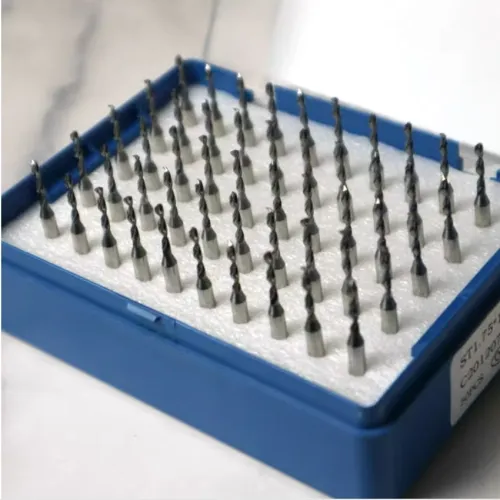
6. Choosing a PCB Router Bit for FR-4
When choosing a PCB router bit for FR-4, consider the laminate’s abrasive reinforcement, stack arrangement, and required edge condition. Different FR-4 constructions should not automatically be treated as identical machining loads.
PCB routing chip evacuation depends on more than the flute pattern. Check:
- Cutting zone: Whether chips and dust can leave without accumulating or being repeatedly recut.
- Extraction path: Brush or shroud condition, connections, hoses, and collection performance.
- Workholding: Support before, during, and after the contour is completed.
- Operating parameters: Supplier guidance for the exact series, diameter, and material.
- Toolpath: Entry, corners, full-width engagement, and the final release of individual boards.
An end mill can be used for appropriate PCB operations, but “end mill for PCB” does not identify a universally suitable tool. Confirm material compatibility, geometry, and whether the intended entry motion is permitted. Not every PCB router is approved for straight plunging.
7. Validate PCB Router Bit Tool Life and Cost
PCB router bit tool life ends when the tool reaches the agreed quality or service limit—not only when it breaks.
A controlled trial should track:
- Initial quality: Profile dimensions, slot width, edge condition, and visible damage.
- Progressive change: Results at defined cutting-distance intervals.
- Tool condition: Wear, chipping, deposits, and abnormal events.
- Process consistency: Material, stack, fixture, parameters, and extraction.
- Replacement criteria: The approved limits for quality and tool condition.
Use comparable workloads. Panel count can be misleading if one design contains much more routing length than another.
A practical cost measure is:
Tool-related cost per accepted meter = Attributable tooling, changeover, and quality-loss costs ÷ Accepted routing length
Use the same accounting boundary for each candidate and avoid double-counting downtime and labor. A premium cutter is worthwhile only if its measured benefits justify the added cost.
8. FAQ
Are more flutes better for PCB routing?
Not automatically. Flute count must suit the tool geometry, material, chip clearance, and operating parameters. Special PCB tooth patterns cannot always be compared like conventional end mills.
Can a 3.175 mm shank tool fit any PCB router?
No. The collet must accept the specified shank, but overall length, projection, ring configuration, cutting dimensions, and loading requirements also matter.
Is a diamond-cut router bit made from diamond?
Not necessarily. Diamond-cut usually describes the tooth pattern. Verify whether the tool is uncoated carbide, coated carbide, PCD, or another construction.
Can the same cutter profile bare boards and depanel assembled PCBs?
Only when qualified for both applications. Assembled boards add component-clearance, support, dust-control, and mechanical-loading considerations.
Will a coating eliminate burrs?
No. Coating cannot compensate for unsuitable geometry, unstable workholding, poor extraction, or incorrect operating conditions. Confirm the cause of the burrs before changing tools.