1.What Is a Nylon Brush?
A nylon brush uses nylon filaments to contact, sweep, or scrub a surface. Nylon Brush Rollers, also called a Nylon Roller Brush or Nylon Cylinder Brush, arrange these filaments around a cylindrical core for rotary operation. These names describe the material and shape; they do not establish whether the filaments contain abrasives.
For PCB purchasing, distinguish the two constructions clearly:
- Non-abrasive nylon brush roller: Uses filaments without embedded abrasive particles. The term Pure nylon brush roller is also used commercially, but it does not by itself certify resin purity, nylon grade, or the absence of other additives.
- Abrasive Nylon Brush Roller: Uses nylon filaments containing abrasive particles, commonly silicon carbide or aluminum oxide. Nylon Abrasive Brush Roller and abrasive nylon roller brush refer to the same general product type. Manufacturer documentation confirms nylon-based abrasive filaments containing these minerals.
Both belong to the broader category of industrial brushes. When comparing cylinder brushes, ask for the filament specification rather than relying on the product name or bristle color.
2. Non-Abrasive vs. Abrasive Nylon Brush Rollers
The following comparison assumes the non-abrasive brush operates with a compatible liquid without added abrasive slurry.
| Selection Factor | Non-Abrasive Nylon Brush Roller | Abrasive Nylon Brush Roller |
|---|---|---|
| Filament construction | Nylon without embedded abrasive grit | Nylon containing abrasive particles |
| Main process objective | Remove loose particles and removable residues | Remove oxides, address light burrs, or condition the surface |
| Material-removal action | Less aggressive under comparable conditions; not guaranteed to be zero | Designed to provide abrasive material removal |
| Key selection variables | Nylon grade, filament diameter, trim length, density | The same variables, plus abrasive mineral, grit, and loading |
| Main process risks | Incomplete cleaning, trapped-particle scratches, uneven contact | Excess copper removal, scratches, excessive roughness |
| Acceptance checks | Cleanliness, surface condition, brushing uniformity | Cleanliness, copper removal, roughness, burr condition |
| Typical reason to choose it | Cleaning without intentional surface roughening | A defined surface change is required |
Abrasive nylon brushes are not automatically the better cleaning option. A brush that removes contamination effectively may still be unsuitable if it changes copper thickness or texture beyond the process limit.
Key Types and Stiffness Configurations
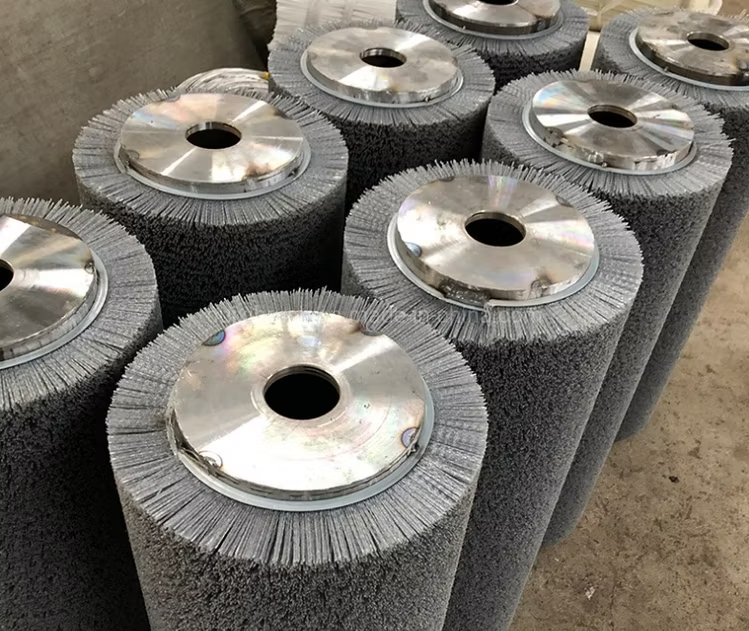
- Medium stiffness nylon brush roller: Standard choice for general horizontal conveyor washing, board transport, and chemical rinsing stages.
- High stiffness nylon brush roller: Designed for heavy-duty dry debris removal, post-routing cleaning, or rigid board pre-washes where higher structural memory is required.
- Non-abrasive nylon brush roller (PA66): Preferred for thin laminates (<0.4mm), HDI layer processing, and flexible boards where zero surface scratching is strictly mandated.
Grit Rating & Material Options
- Silicon Carbide (SiC): Sharp, hard particles ideal for quick copper micro-etching and deburring.
- Aluminum Oxide (ALO): Tougher, less brittle grains providing a rounder micro-scratch profile for delicate outer layers.
- PCB abrasive nylon brush Grit Selection:
#320 - #500: Heavy deburring after mechanical drilling.#600 - #1000: Standard pre-lamination and pre-solder mask surface roughing.#1200 - #1500: Ultra-fine treatment for HDI boards and thin copper foils (<12μm).
3. Choosing a Nylon Brush for PCB Wet Process Applications
Start by identifying what the brushing stage must remove and what the following process needs. A nylon brush for PCB wet process equipment should be specified together with its liquid, operating temperature, and contamination load.
Use a non-abrasive brush for cleaning-focused tasks
A nylon brush for PCB cleaning is a candidate when the objective is to loosen particles or removable residues while preserving the existing surface as much as possible.
- Check whether brushing and rinsing remove the actual contamination.
- Confirm compatibility with the cleaning solution.
- Inspect for particles trapped between the bristles.
- Do not expect plain nylon filaments to replace a qualified oxide-removal or roughening process.
Use an abrasive brush when the surface must change
A PCB abrasive nylon brush is a candidate when the process calls for controlled abrasion. PCB brush manufacturers identify abrasive-filament applications including copper scrubbing, oxidation removal, and preparation for resist adhesion.
- Define the allowable copper removal before selecting the brush.
- Specify the required surface finish rather than requesting “stronger cleaning.”
- Match abrasive grade to the initial surface condition.
- Validate the result with the downstream coating or imaging process.
Treat pumice scrubbing as a separate process choice
Plain nylon filaments can distribute pumice slurry across the board. Consequently, non-abrasive filaments do not necessarily mean a non-abrasive process. Gordon Brush describes PCB nylon roller brushes specifically designed for pumice distribution.
Switching from slurry-assisted brushing to embedded-abrasive filaments changes the process and requires qualification; it is not simply a replacement of one roller with another.
4. Selecting a Nylon Brush for a Horizontal PCB Line
A nylon brush for horizontal PCB line equipment must match both the machine and the board range. Two rollers with the same outer diameter can perform differently because their bristle length, density, core design, or mounting differs.
Before ordering, confirm:
- Mechanical fit: Outer diameter, working width, overall length, bore or shaft dimensions, and mounting details.
- Board handling: Minimum board thickness, panel size, support arrangement, and resistance to deflection during brushing.
- Operating conditions: Rotation direction, approved speed range, conveyor speed, and contact adjustment method.
- Liquid system: Solution compatibility, flow distribution, drainage, and contamination control.
- Replacement limits: Minimum usable diameter and permitted adjustment as the brush wears.
5. Maintenance and Replacement
Brush condition and process settings should be reviewed together. Increasing pressure to compensate for poor cleaning can conceal the cause and accelerate wear.
| Observation | Checks Before Adjusting the Process |
|---|---|
| Streaks or uneven cleaning | Alignment, wear profile, liquid distribution, and board support |
| New scratches | Trapped debris, damaged filaments, contamination, and excessive contact |
| Excessive copper removal | Abrasive grade, contact, conveyor speed, and repeated passes |
| Weak cleaning performance | Contamination type, worn bristles, cleaning chemistry, and liquid flow |
| Bent or shedding filaments | Mechanical interference, over-compression, chemical exposure, and brush construction |
Replace the roller when damage, wear, or persistent contamination prevents acceptable performance. Keep maintenance and trial records so replacement decisions are based on results rather than a fixed calendar interval.
6. FAQ
1. What is the main difference between a nylon brush roller and a nylon abrasive brush roller?
For this comparison, a standard nylon brush roller uses filaments without embedded abrasive particles. A nylon abrasive brush roller contains abrasive grains within the filaments, providing cutting action for oxide removal, light deburring, and surface conditioning.
2. Which brush roller should I choose for PCB cleaning?
Choose a non-abrasive nylon brush roller when the main task is removing loose particles and removable residues. Consider an abrasive nylon brush roller when the process requires a measurable surface change. Base the decision on cleanliness, allowable copper removal, and the requirements of the next process.
3. Can a non-abrasive nylon brush roller scratch copper?
Yes. Trapped particles, contaminated process liquid, or excessive contact can scratch the surface even when the bristles contain no abrasive. Keep the brush clean and validate contact settings on representative boards.
4. Can a stiffer nylon brush replace an abrasive nylon brush?
Not as a direct equivalent. Stiffer bristles change the mechanical contact but do not reproduce the cutting action of embedded abrasive particles. A replacement must meet the same cleaning, copper-removal, and surface-finish requirements through testing.
5.How often should abrasive nylon brush rollers be dressed or trued?
Abrasive nylon brush rollers develop a center-wear profile over time due to the frequent passage of narrower panel widths. Weekly or bi-weekly dressing using a pumice dressing board or truing stone is recommended to flatten the brush cylinder profile across its full face length, ensuring uniform footprint pressure across all panel sizes.
 English
 German
 French
 Spanish
 Vietnamese
 Russian