
PCB Silk Screen Copper Pin
$0.2 – $1 / pcs
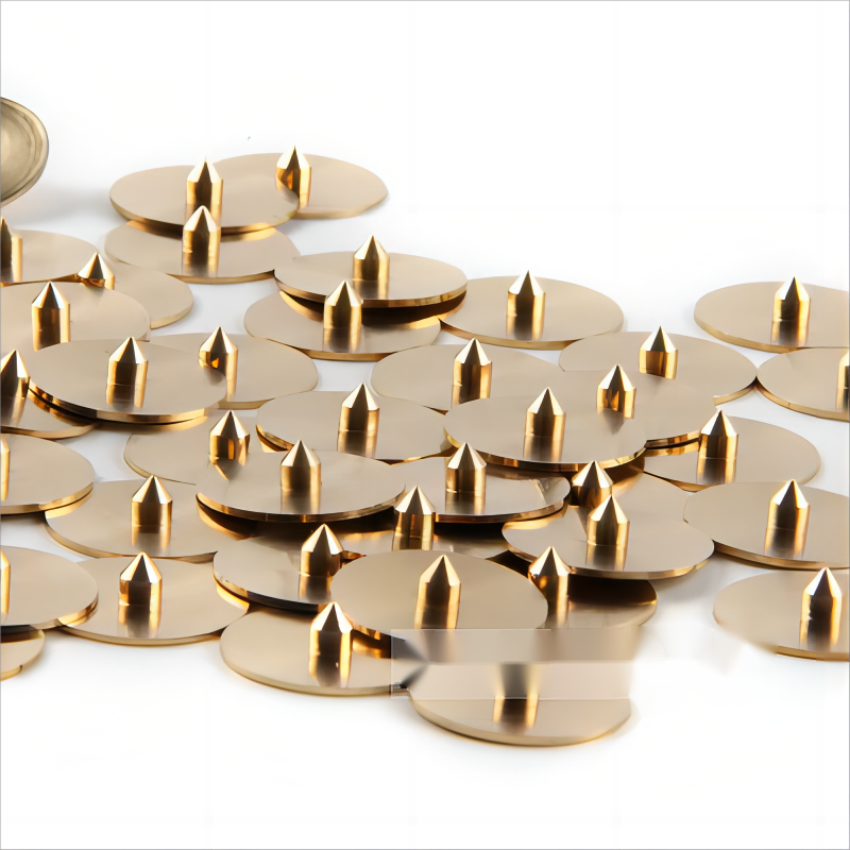
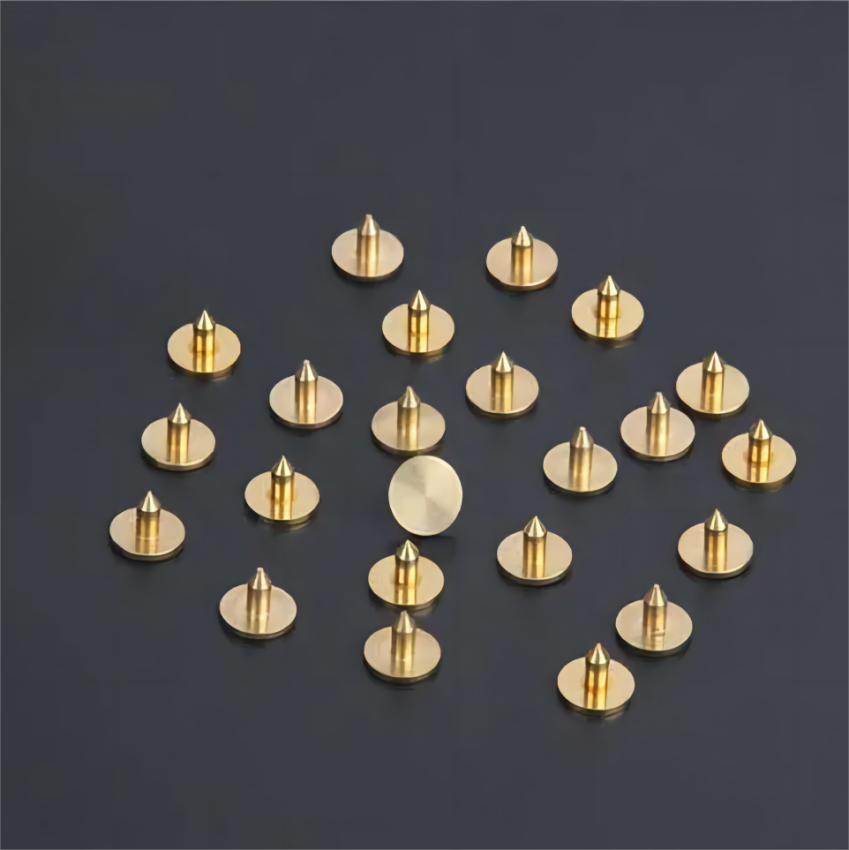
PCB Silk Screen Copper Pin used in the PCB manufacturing to align and fix the screen printing template when solder paste or non-conductive ink is printed onto the PCB.
Material: Pure copper
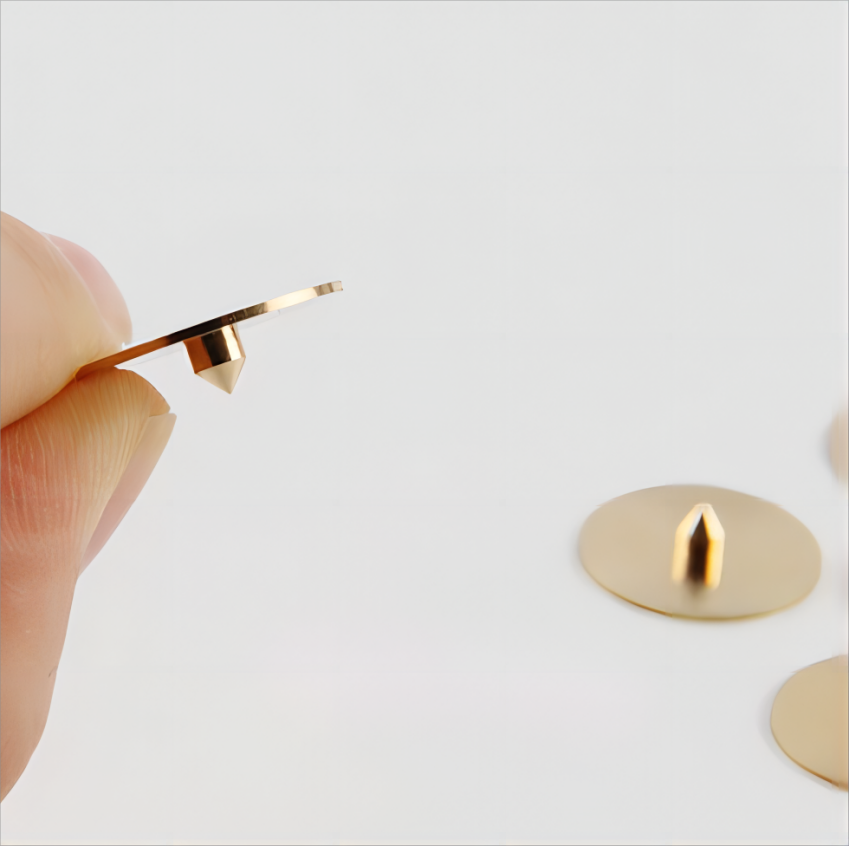
Diameter:15mm, thickness: 0.6mm
Total Hight:3.9mm or other customized
1.PCB Silk Screen Copper Pin Overview
During the PCB screen printing process, carlson pin are used as physical positioning references and inserted into pre-drilled holes or tool holes on the PCB to ensure that the solder mask layer, character layer and other graphics are accurately aligned with the underlying circuit. Especially in double-sided or multi-layer board printing, copper pins can avoid short circuits or recognition errors caused by screen printing offset.
Conductive function (special scenarios)
In automated screen printing equipment, copper needles can fix the PCB position to prevent the board from moving during printing and improve the yield. Its rigid structure can resist ink tension and maintain printing stability.
The size can be customized. Widely used in 6-18 layers of printed board lamination positioning, double-sided, multi-layer printed board optical imaging graphics transfer
2.Tehnical data for copper screen pin
| Material | Pure copper |
| Base plate size | Diameter: 15mm, thickness: 0.6mm |
| Pin size | Diameter: 3mm, height: 3.3mm,normally it’s packed by 1000pcs/pack |
| Total Hight | 3.9mm or other customized |
3. Material and process requirements
Material selection
Copper screen printing needle usually uses high-purity oxygen-free copper because of its excellent conductivity and strong corrosion resistance. The surface is usually nickel-plated, gold-plated or passivated to prevent oxidation and improve adhesion with ink. For example, the gold-plated layer can reduce the transmission loss of high-frequency signals.
Manufacturing accuracy
The diameter tolerance of the copper needle must be controlled within ±0.005mm, and the length consistency requirements must be strict to avoid tilting during insertion. The tip shape is diverse:
Round head: suitable for general positioning, reducing damage to the PCB hole wall.
Conical: convenient for inserting thin flexible boards, reducing the risk of puncture.
Flat head: used for conductive scenarios that require flat contact.
4. Typical application scenarios
Solder mask printing
The copper needle is inserted into the PCB positioning hole to fix the board position, ensuring that the solder mask ink accurately covers the pad to avoid short circuits caused by exposed copper foil.
Alignment between layers of multi-layer boards
Combined with the optical positioning system, the copper needle is used as a mechanical reference to assist the alignment of the inner layer circuit and the outer layer silk screen to ensure the accuracy of the interlayer connection.
5. Comparison with similar tools
The functions of silk screen copper needles are similar to those of steel mesh positioning needles, carbon fiber positioning pin, etc., but the materials and applicable scenarios are different:
Steel mesh positioning needles: usually made of stainless steel, used to fix the relative position of the steel mesh and PCB before the SMT patch, focusing on the accuracy of solder paste printing.
Carbon fiber positioning pins: lightweight and highly rigid, suitable for precision optical component assembly, but poor conductivity.
Silk screen copper needles: taking into account both conductivity and positioning, specially designed for PCB silk screen printing process, especially suitable for scenes requiring temporary conductivity or high-frequency signal transmission.
6. Selection and usage suggestions
Choose according to PCB type
Hard board (FR4): Prefer copper needles with a diameter of 0.5-1.0mm, which are strong enough to resist ink pressure.
Flexible board (FPC): Use conical tip copper needles to avoid piercing the substrate; gold-plated surface to improve wear resistance.
High frequency board: Use gold-plated copper needles to reduce signal loss; the tip needs to be polished to reduce contact resistance.
Maintenance and care
Regularly clean the oil on the surface of the copper needle to prevent ink residue from affecting conductivity. It can be wiped with an alcohol swab, and avoid using corrosive solvents.
Apply anti-rust oil during storage to prevent the coating from falling off; it can be sealed and stored in a dry environment if not used for a long time.
Severely worn copper needles need to be replaced in time to prevent positioning deviation from causing poor printing.
Automation compatibility
If used in a fully automatic screen printer, it is necessary to confirm that the copper needle length matches the device fixture. For example, some devices require the total length of the copper needle to be 25±0.1mm.
Some devices support quick replacement of copper needle modules, which can improve production efficiency through magnetic suction or snap-on design.


 Russian
  English
  German
  French
  Spanish
  Vietnamese