
What Are CNC Collets?
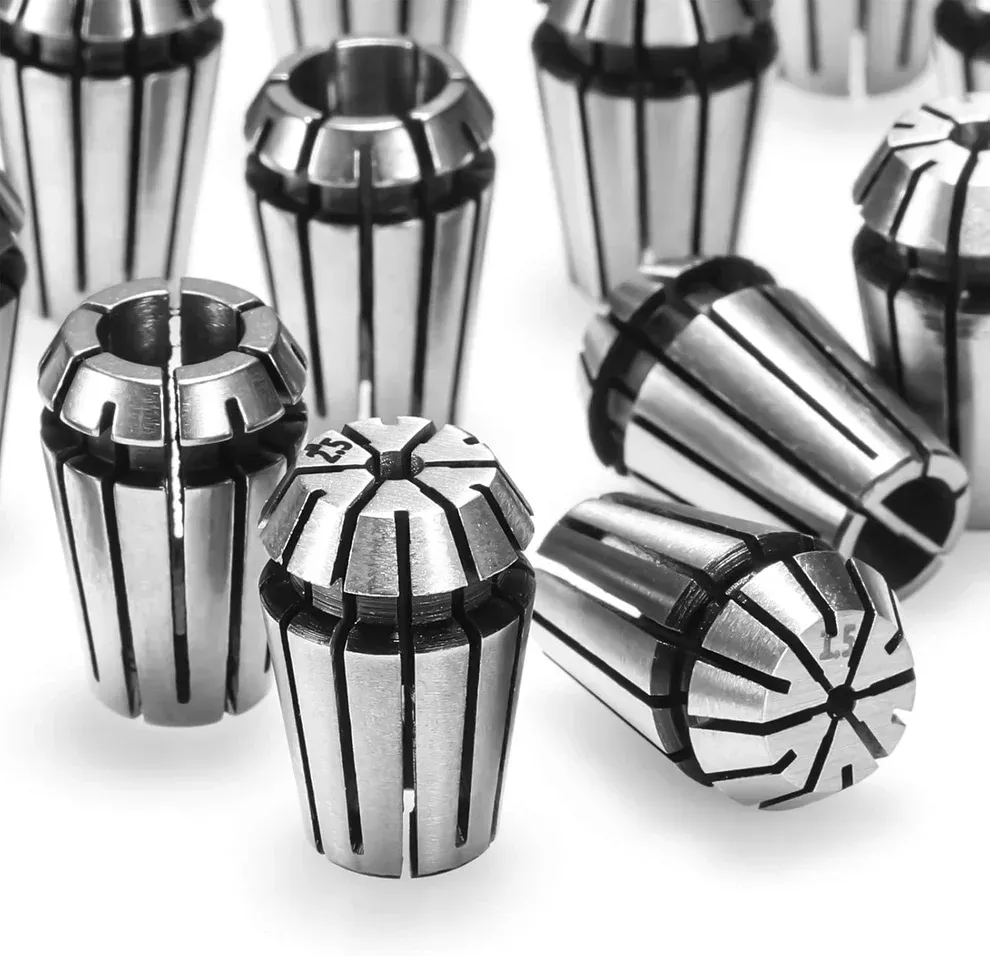
CNC collets are spring-loaded precision holders that clamp cutting tool shanks using elastic deformation. When a collet nut tightens, the collet’s slotted body compresses radially, creating uniform clamping force around the entire tool circumference. This mechanism ensures concentricity that rigid holders simply cannot match.
Main CNC Collets Types
| Collet Type | Taper Angle | Clamping Range | Primary Application | Key Strength |
| ER Collet | 16º | High (up to 1mm) | General Milling & Drilling | Versatility & standard availability |
| 5C Collet | 10º | Low (size specific) | Lathe Workholding | Excellent concentricity for round parts |
| TG Collet | 4º | Medium | Heavy-Duty Milling | Maximum gripping power (Tremendous Grip) |
| R8 Collet | 16º 51′ | Low (size specific) | Manual Milling (Bridgeport) | Direct spindle mounting |
| DA Collet | Double Angle | Low | High-Production Drilling | Compact design for tight spaces |
| SK Collet | 8º | Low | High-Speed Machining | Superior balance and low run-out |
CNC Collets Sizes: The ER Collet Size Chart
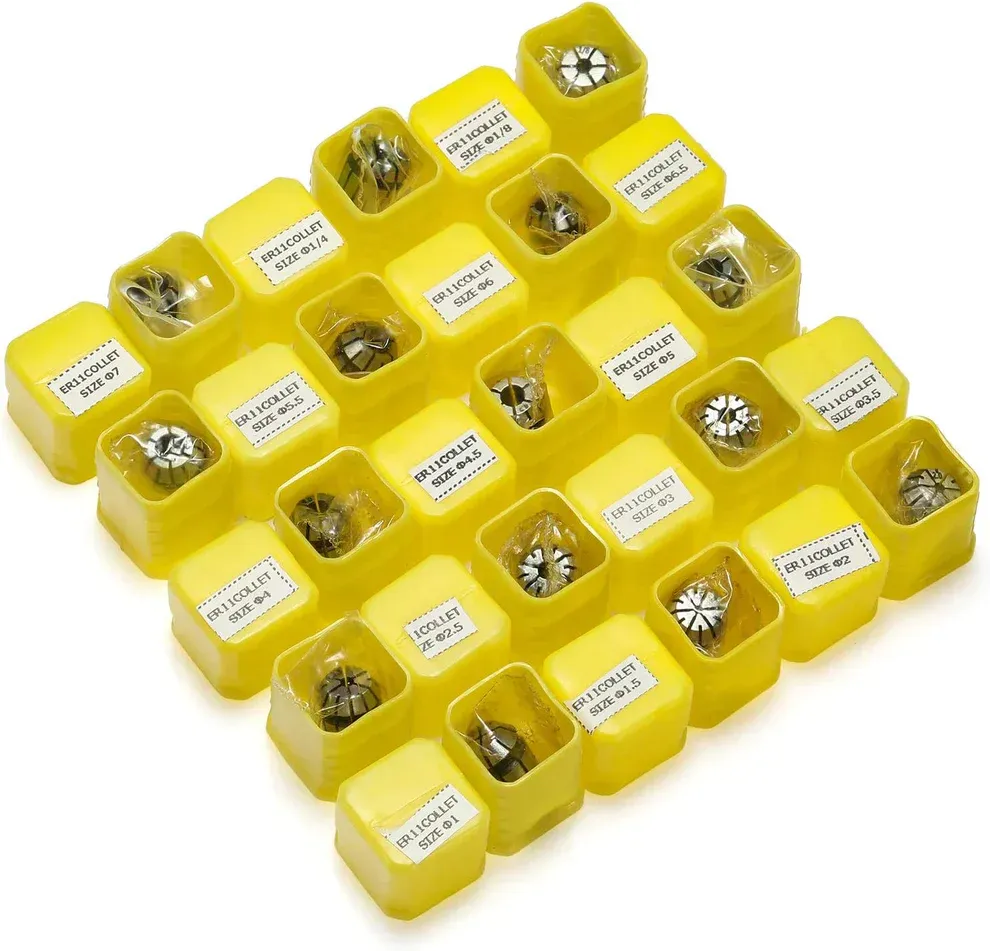
Choosing between different collet sizes requires a clear understanding of your tool shank diameters. The following ER collet size chart highlights the standard metric dimensions used in 2026.
| Collet Standard | Major Diameter | Length | Max Clamping Range |
| ER11 | 11.5mm | 18mm | 0.5mm – 7mm |
| ER16 | 17mm | 27mm | 1mm – 10mm |
| ER25 | 26mm | 34mm | 2mm – 16mm |
| ER32 | 33mm | 40mm | 2mm – 20mm |
| ER40 | 41mm | 46mm | 3mm – 26mm |
Critical Performance Factors
1. Total Integrated Run-out (TIR)
TIR is the most critical measure of precision. It quantifies the deviation between the tool’s central axis and the spindle’s theoretical center of rotation.
- Impact: Excessive run-out causes uneven tooth loading, leading to accelerated tool wear, poor surface finish, and potential tool breakage.
- Standards: Standard CNC collets typically offer TIR within 10μm, while Ultra-Precision (UP) grade CNC collets achieve 3μm.
2. Clamping Force (Grip Strength)
This is the radial pressure the collet exerts on the tool shank to ensure it remains stationary under high torque or heavy cutting loads.
- Taper Influence: A shallower taper (like the 4º in TG Collets) generates immense clamping force, whereas the ER system (16º) balances grip with versatility.
- Safety: Inadequate clamping leads to “tool pull-out,” which can damage the workpiece and the spindle internal taper.
3. Dynamic Balance
In high-speed applications like PCB drilling, where spindles exceed 200,000 RPM, any minor mass asymmetry creates violent vibrations.
- Rating: High-performance collets must meet G2.5 or higher balancing standards.
- Benefits: Proper balance ensures stability at high velocities, protects spindle bearings from premature failure, and improves hole wall quality.
4. Collapse Range & Elasticity
This refers to the collet’s ability to shrink its diameter while maintaining a parallel grip on the tool shank.
- Versatility: The ER series is famous for its 1mm collapse range, allowing it to accommodate various tool sizes.
- Accuracy Trade-off: Generally, the further a collet must collapse, the higher the risk of increased run-out. For maximum precision, it is best to use a collet size that matches the tool diameter exactly.
5. Material & Heat Treatment
The durability of a spring collet depends on its metallurgy and quenching process.
- Spring Steel: High-quality steel ensures the collet maintains its “elastic memory,” returning to its original shape after thousands of cycles.
- Beryllium Copper: Often used in PCB drilling for its excellent thermal conductivity and superior elasticity under high-frequency operation.
How Do Collets Work? The Mechanics
If you’ve ever asked how do collets work, the answer lies in the physics of the inclined plane.
- The spring collet is placed inside the tapered bore of a collet chuck.
- A nut is tightened, pushing the collet deeper into the taper.
- The slits in the collet design allow the metal to compress, shrinking the internal diameter.
- This results in a uniform, high-pressure grip on the tool shank or workpiece.
CNC Collet Installation: Step-by-Step
Correct installation is vital to prevent tool breakage and ensure operator safety.
- Clean the Surfaces: Use a clean cloth to remove any oil or debris from the collet chuck taper and the spring collet itself.
- Snap the Collet into the Nut: For ER systems, the collet must be snapped into the eccentric ring of the nut before being inserted into the holder. You should hear a distinct “click.”
- Insert the Tool: Slide the drill or mill into the collet. Ensure the shank is inserted at least 2/3 of the way into the collet bore.
- Hand Tighten: Thread the nut onto the holder by hand.
- Torque to Spec: Use a calibrated torque wrench. Over-tightening can distort the collet design, while under-tightening leads to tool slippage.
How to Choose & Maintain Your CNC collets
Choosing the right cnc collet depends on your application:
- For High-Speed Drilling: Use ER or DA collets.
- For Heavy Milling: Choose TG Collets or high-precision ER systems.
- For Precision Turning: Opt for 5C Collets.
Maintenance Best Practices:
- Ultrasonic Cleaning: Periodically clean your CNC collets in an ultrasonic bath to remove micro-chips and dried coolant.
- Replacement Cycles: Even the best collet manufacturing cannot prevent metal fatigue. In high-volume shops, CNC collets should be replaced every 6 to 12 months.
- Inspect for Fretting: Look for small, dark pits on the taper. This “fretting” indicates the collet is vibrating in the holder and needs replacement.
 Russian
  English
  German
  French
  Spanish
  Vietnamese