
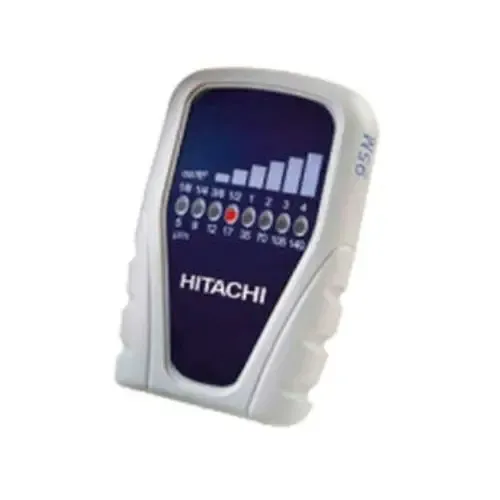
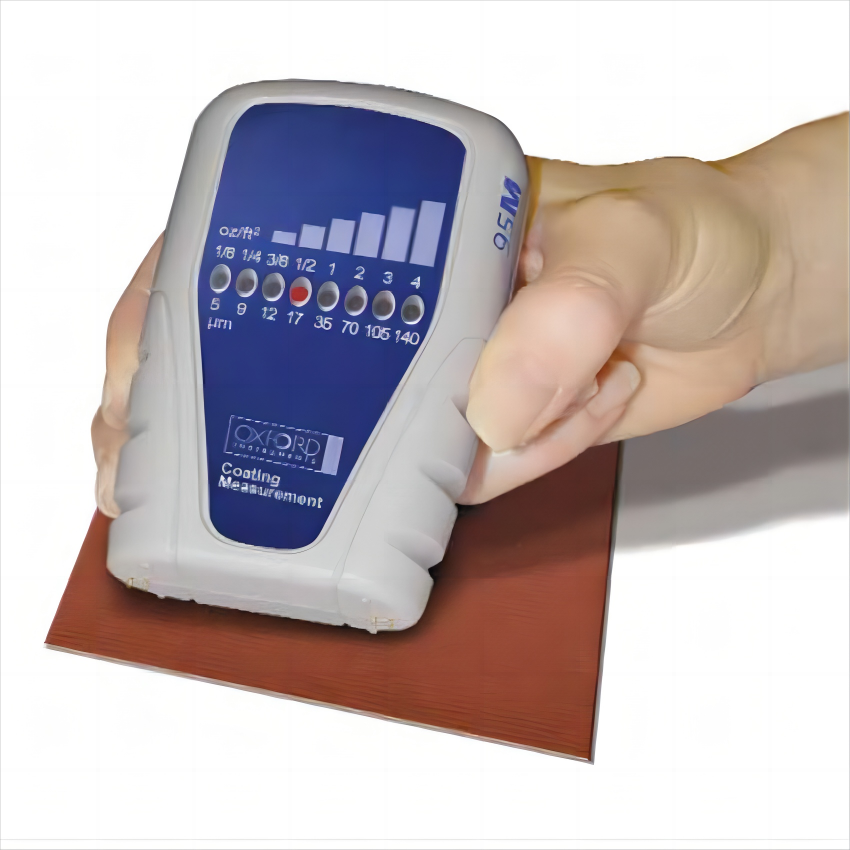
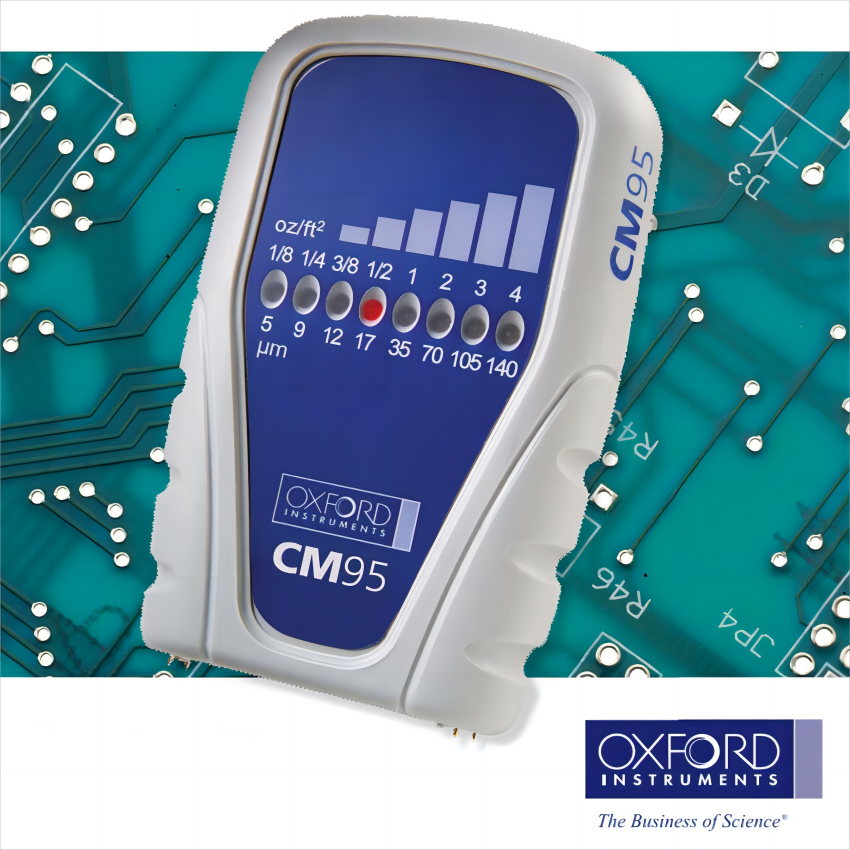
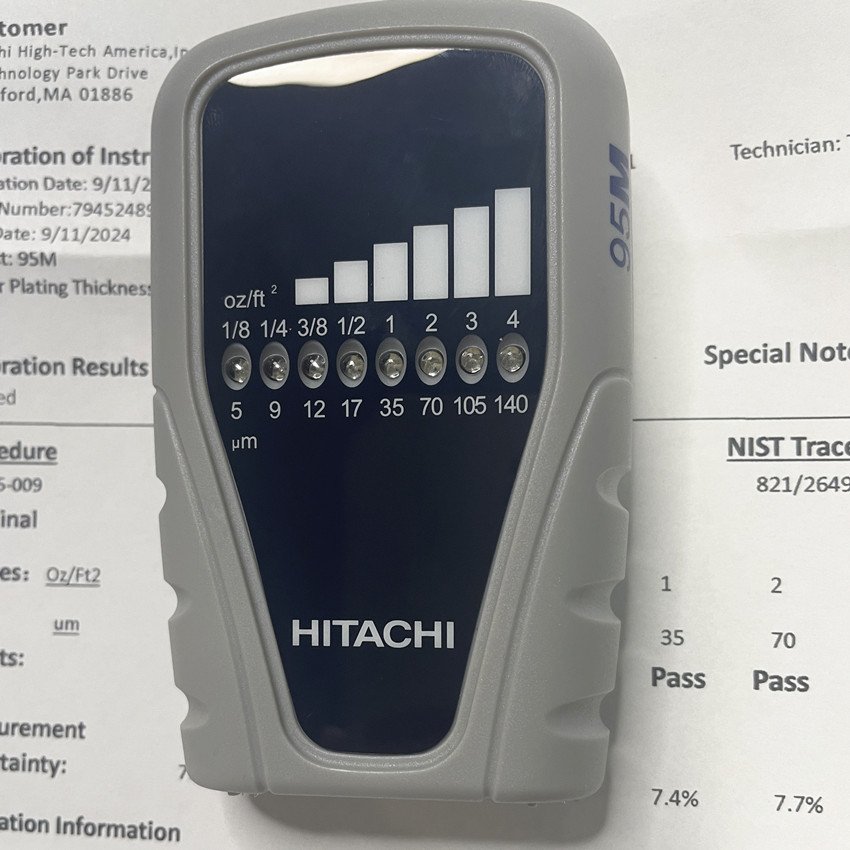
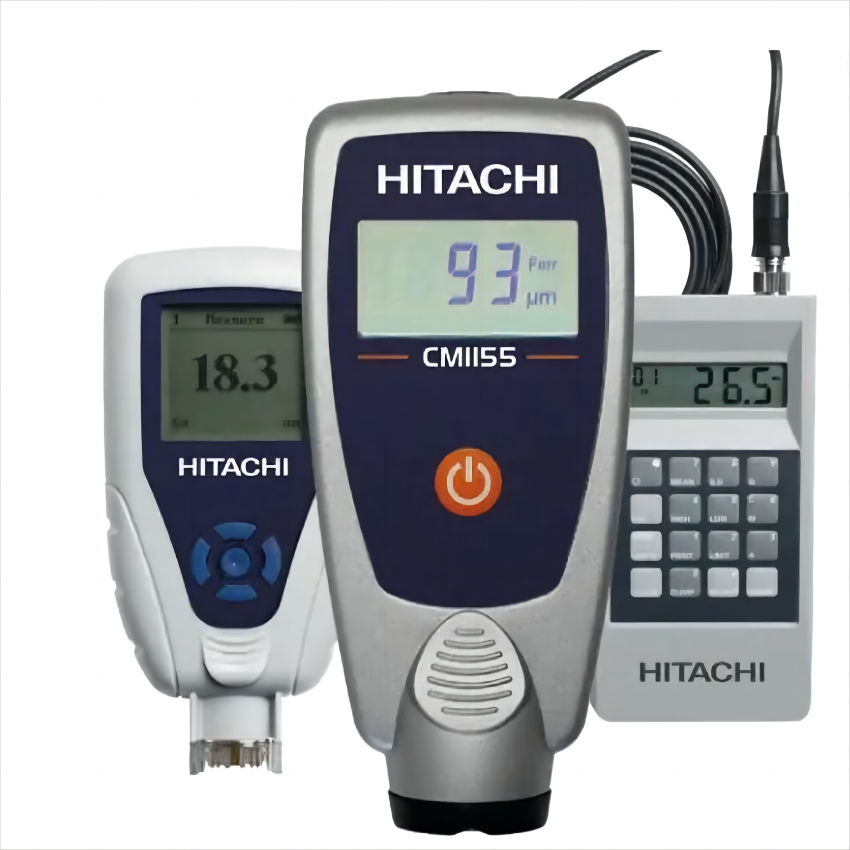
Hitachi CMI95M Copper Thickness Classification Gauges
$700.00
Hitachi CMI95M Thickness Gauges is a handheld, non-destructive thickness measurement instrument that utilizes advanced micro-resistance technology to provide highly accurate, substrate-independent measurements of surface copper thickness on printed circuit boards.
1. Hitachi CMI95M Thickness Gauges Overview
Hitachi CMI95M Thickness Gauges is a handheld digital thickness gauge that specializes in measuring Surface Copper Thickness. Unlike traditional eddy-current gauges that can be influenced by the substrate material or the copper on the opposite side of a board, the CMI95M uses a Four-Point Probe method.
This thickness gauge meter is designed for speed and portability. It allows inspectors to move quickly across a large panel to ensure uniformity. Whether you are measuring Electroless Copper or Electrodeposited Copper, the CMI95M provides the high precision thickness data required to prevent costly scrap and ensure the electrical integrity of the final product.
2. Core Functionality: The Four-Point Probe Method
The technical superiority of the Hitachi CMI 95M lies in its use of micro-resistance technology. The probe features four securely encased pins. During a measurement, the device passes a constant current through the two outer pins and measures the voltage drop across the two inner pins.
Key Technical Features:
Substrate Independent: The measurement is unaffected by the laminate thickness or the presence of inner layers. This makes it a superior thickness tool for multi-layer board inspection.
Automatic Temperature Compensation: Copper resistance changes with temperature. The CMI95M includes a sensor that adjusts the reading to provide a consistent thickness value regardless of the ambient shop floor temperature.
Trace Measurement: The unique probe geometry allows for pcb thickness measurement on fine lines and traces, not just wide-open copper planes.
Digital Gauge Meter Display: The high-contrast gauge meter digital interface shows the thickness unit (mils, $\mu m$, or $oz$) clearly, reducing the chance of operator misinterpretation.
3. Industrial Applications and PCB Quality Control
In the Electronics Manufacturing sector, the Hitachi CMI95M is utilized at several critical checkpoints.
Post-Etch Inspection
After the etching process, it is vital to ensure that the thickness of pcb board copper traces remains within the specified tolerance. If the copper is too thin, the circuit may overheat or fail under load. The CMI95M serves as the primary thickness gauge tool for this verification.
Electroless vs. Electrodeposited Copper
The 95M is a versatile coating thickness gauge. It can be toggled between different copper types. Since electroless copper has a different conductivity profile than electrolytic copper, the device uses specific algorithms to ensure the unit of thickness displayed is accurate for the specific material being tested.
Incoming Material Audit
Quality teams use the 95M as a thickness measurement instrument to verify the copper weight of incoming copper-clad laminates (CCL). This ensures that the standard pcb thickness promised by the supplier is what is actually delivered to the production line.
4. Technical Characteristics and Data Handling
The CMI95M Thickness Gauges is designed for high-throughput environments where data integrity is paramount.
Data Precision:
Measurement Units: Supports multiple thickness measurement units, including micrometers ($\mu m$), mils, and ounces ($oz$).
Resolution: Offers resolution down to 0.01 mils or 0.1 $\mu m$.
Accuracy: Typically achieves an accuracy of ±1% relative to a known Calibration Standard.
Memory: The digital thickness gauge can store thousands of readings, allowing for statistical analysis of a production lot.
5. Maintenance and Calibration Protocols
To maintain the performance of any coating measurement instruments cmi, a strict calibration and maintenance routine must be followed.
Using the Calibration Standard
The CMI95M Thickness Gauges is supplied with a set of NIST-traceable Calibration Standard plates. Because the probe pins are mechanical, they can wear over time. By performing a daily check against a known unit of thickness, the operator can “zero” the device and ensure that the thickness gauge tool is performing within factory specifications.
Probe Care and Troubleshooting
If the gauge meter digital display provides “out of range” messages or inconsistent results, it may indicate a damaged probe tip. The CMI95M probe is a delicate thickness measurement tool; the pins must be kept clean of oxidation and debris. Using a specialized Hitachi probe maintenance kit can significantly extend the probe lifetime.
| CMI95M | CMI165 | CMI511(CMI500) | CMI563 | CMI760(CMI700) | |
| Technique | Microresistance | microresistance | Eddy curreny | microresistance | microresistance |
| Copper Foil | √ | √ | × | √ | √ |
| Copper Clad Laminate(CCL) | √ | √ | × | √ | √ |
| Copper-Surface | × | √ | × | √ | √ |
| Copper-Fineline | × | √ | × | √ | √ |
| Copper Thru-hole | × | × | √ | × | optional |
| Temperature Compensation | × | √ | √ | × | √ (ETP Probe) |
| Replacement Probe Tip | × | √ | × | √ | √ (SRP-4 Probe) |
| Unit Selection | oz or um | mil or um | mil or um | mil or um | mil or um |
| Thickness Range | 8 indicator lights 1/8-4 oz 5-140 um | Electroless Cu 0.01-0.5 mil 0.25-12.7 um Electroplated Cu 0.1-10 mil 2-254 um | 0.08-4.0 mil 2-102 um | Electroless Cu 0.01-0.5 mil 0.25-12.7 um Electroplated Cu 0.1-6 mil 3-152 um | Surface Cu 0.01-10 mil 0.25-254 um Thru-hole Cu 0.05-4 mil 1-102um |


 Russian
  English
  German
  French
  Spanish
  Vietnamese