
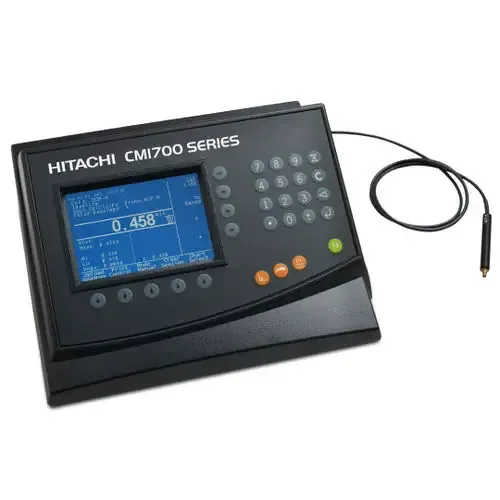
Hitachi CMI700 Copper Thickness Gauges
$9,000.00
Hitachi CMI760 Copper Thickness Gauges is a high-performance, benchtop coating thickness gauge that utilizes advanced magnetic induction and eddy current technologies to provide precise, non-destructive thickness measurement for the electronics manufacturing and metal finishing industries.
Hitachi CMI760 Thickness Gauges Overview
Hitachi CMI760 Thickness Gauges is a benchtop thickness gauge designed for high-volume production environments. It is a multi-functional system that typically utilizes both induction and eddy-current technologies to measure the thickness of metallic and non-metallic coatings. Unlike a simple digital thickness gauge, the CMI700 is built to handle complex geometries and diverse material combinations, such as zinc over steel, cadmium over steel, or copper over plastic.
This thickness measurement tool is the successor to the highly successful CMI series previously developed under the Oxford Instruments brand. Today, under Hitachi High-Tech, it continues to be the preferred digital gauge meter for quality control labs worldwide that require automated data collection and NIST-traceable accuracy.
2. Core Functionalities and Features
Thickness Gauges is more than just a thickness tool; it is a comprehensive data management system. Its core features are designed to minimize human error and maximize throughput.
Dual-Technology Integration
The system allows for the connection of multiple probes, enabling it to switch between magnetic induction (for non-magnetic coatings over magnetic substrates) and eddy current (for non-conductive coatings over conductive substrates). This makes it a versatile coating thickness gauge for shops that handle varied contracts.
Advanced User Interface
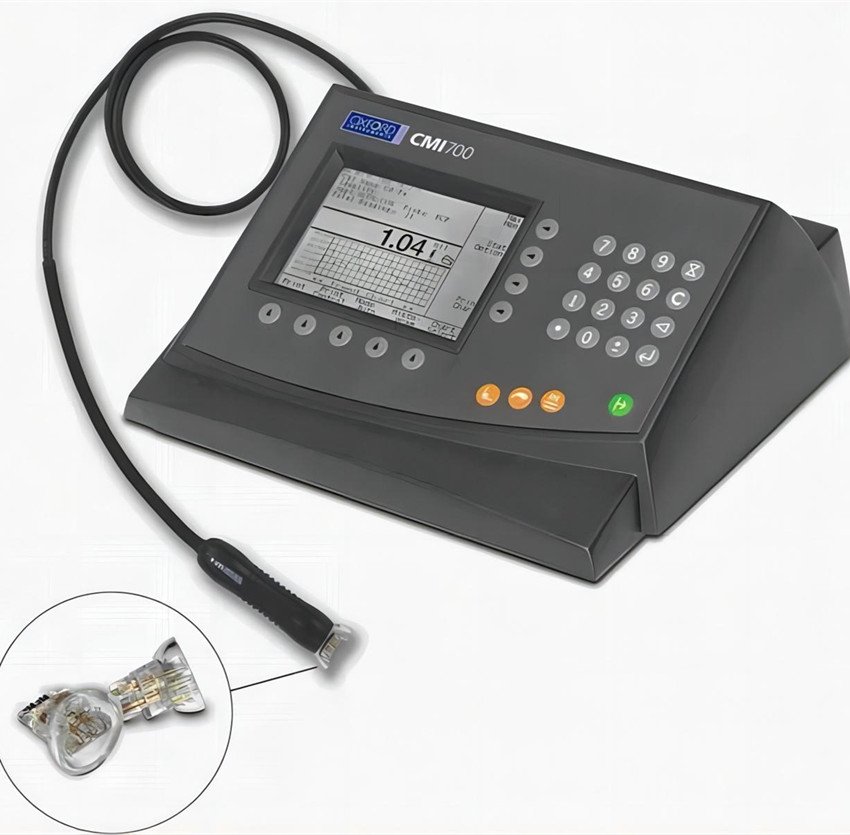
The gauge meter digital display provides real-time statistics, including mean, standard deviation, and coefficient of variation. This allows operators to perform pcb thickness measurement and instantly know if a batch meets the standard pcb thickness requirements.
Robust Calibration
Every thickness gauge tool is only as good as its reference point. The CMI700 supports multi-point Calibration Standard routines. By using a certified unit of thickness reference (such as NIST-traceable shims), the device ensures that the thickness unit displayed on the screen is accurate to the sub-micron level.
3. Thickness Gauges Application Fields
The application of the CMI700 Thickness Gauges spans across several high-stakes industries, each with unique thickness units and tolerance requirements.
Electronics Manufacturing and PCB Inspection
One of the primary uses of this thickness measurement instrument is in the inspection of printed circuit boards. Engineers must verify the thickness of pcb board layers to ensure signal integrity and heat dissipation. Whether checking the core thickness of a multi-layer stack or ensuring the standard pcb board thickness of 1.6mm is maintained, the CMI700 provides the necessary precision.
Automotive and Aerospace
In these sectors, coating thickness gauges are used to measure anti-corrosion layers. The thickness of pcb board components in automotive ECUs must be strictly controlled to withstand harsh environments. The CMI1700 serves as a critical thickness measurement instrument for testing brake lines, fasteners, and engine components.
Metal Finishing and Electroplating
For the Surface Finishing Industry, the CMI700 Thickness Gauges measures gold, silver, tin, or copper plating. Because the tool supports various thickness measurement units (mils, $\mu m$, millimeters), it can be adapted to international standards seamlessly.
4. Technical Data and Probe Characteristics
The performance of the Hitachi CMI 700 Thickness Gauges is largely defined by its probe compatibility and data handling.
Probe Versatility
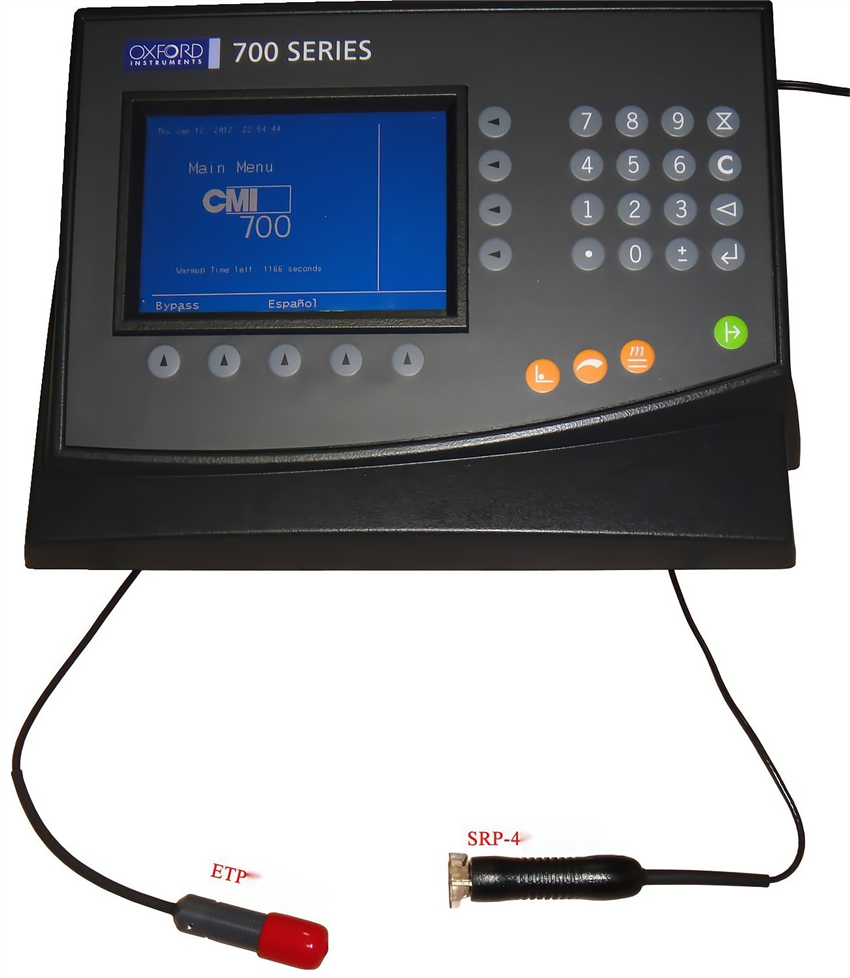
The CMI700 can be equipped with various probes, such as the ETP for through-hole measurement or the SRP-4 for surface copper. These probes are the primary thickness measurement tool interface, designed to handle the delicate nature of pcb thickness testing without scratching the surface.
Data Characteristics:
High Resolution: The digital thickness gauge offers resolution down to 0.01 $\mu m$ (0.001 mils).
Statistical Memory: Storage for thousands of readings, categorized by “Jobs” or “Lots.”
Substrate Compensation: Automatically adjusts for the “base” metal effect, ensuring that the thickness gauge meter only measures the coating, not the underlying material.
Accuracy: Typically ±1% when calibrated against a proper Calibration Standard.
5. Maintenance and Calibration Protocols
To ensure the longevity of your thickness gauges, a strict maintenance schedule is required.
Calibration Standard Usage
Regular use of a Calibration Standard is mandatory. Over time, probe tips can wear down, slightly changing the distance between the sensor and the substrate. By recalibrating with a known unit of thickness, you reset the thickness gauge tool to its factory-spec accuracy.
Troubleshooting the Digital Gauge Meter
If the gauge meter digital display shows erratic readings, it often indicates a “geometry effect” or a “boundary effect.” The CMI700 includes features to compensate for these, but the operator must ensure the probe is perpendicular to the surface during pcb thickness measurement.
| CMI95M | CMI165 | CMI511(CMI500) | CMI563 | CMI760(CMI700) | |
| Technique | Microresistance | microresistance | Eddy curreny | microresistance | microresistance |
| Copper Foil | √ | √ | × | √ | √ |
| Copper Clad Laminate(CCL) | √ | √ | × | √ | √ |
| Copper-Surface | × | √ | × | √ | √ |
| Copper-Fineline | × | √ | × | √ | √ |
| Copper Thru-hole | × | × | √ | × | optional |
| Temperature Compensation | × | √ | √ | × | √ (ETP Probe) |
| Replacement Probe Tip | × | √ | × | √ | √ (SRP-4 Probe) |
| Unit Selection | oz or um | mil or um | mil or um | mil or um | mil or um |
| Thickness Range | 8 indicator lights 1/8-4 oz 5-140 um | Electroless Cu 0.01-0.5 mil 0.25-12.7 um Electroplated Cu 0.1-10 mil 2-254 um | 0.08-4.0 mil 2-102 um | Electroless Cu 0.01-0.5 mil 0.25-12.7 um Electroplated Cu 0.1-6 mil 3-152 um | Surface Cu 0.01-10 mil 0.25-254 um Thru-hole Cu 0.05-4 mil 1-102um |


 Spanish
  English
  German
  French
  Vietnamese
  Russian