
What is a PVA Brush Roller?
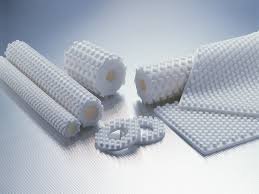
PVA brush roller (also known as PVA sponge roller) is a porous hydrophilic cleaning roller widely fitted on PCB horizontal wet process lines. It is made of cross-linked PVA hydrogel material, with interconnected micro-pores for fast water absorption and uniform squeezing.
Surface Pattern Selection Guide
Selecting the proper surface geometry depends on panel thickness, hole density, conveyor speed, and process chemistry:
| Surface Pattern | Mechanical Structure | Primary Application | Key Advantage |
| Nodular / Mushroom Tip | Array of soft, cylindrical nodes protruding from the roller core | Multi-layer boards, HDI panels, post-drilling scrub | High debris trapping capability; flexible nodes clean around hole edges |
| Ribbon / Spiral Ridge | Continuous helical ridges around the roller body | High-speed horizontal conveyor lines, panel dewatering | Directional channels sweep liquid and particles outward toward panel margins |
| Smooth / Fine-Pore | Uniform cylindrical surface without raised projections | Ultra-thin core handling, IC substrate final rinse | Gentle, uniform contact pressure; minimizes thin-core wrapping around rollers |
How to Select a PVA Brush Roller for PCB Cleaning
Select a PVA brush roller according to the contamination, board surface, and operating conditions. Matching the dimensions is necessary, but it does not establish cleaning performance.
1. Define the cleaning task.
Identify what must be removed and how the result will be inspected. Distinguish contact cleaning from rinse-water removal: an absorbent roller is not automatically suitable for scrubbing.
2. Confirm the board surface.
Specify whether the roller will contact exposed copper, photoresist, solder mask, or another surface. Compatibility with the actual surface and process must be verified.
3. Check dimensions and mounting.
Provide the working diameter, effective length, overall length, bore, core, and mounting details. State whether dimensions apply to the dry or conditioned roller.
4. Evaluate surface geometry and material grade.
Compare smooth and nodular designs against the intended task. Request hardness and pore-structure information with the relevant test methods and conditioning state.
5. Verify chemical compatibility.
Give the supplier the cleaning chemistry, concentration, temperature, and exposure duration. Include maintenance chemicals, and check compatibility with the sponge, core, and bonding materials.
6. Validate before production release.
Trial the proposed roller on representative panels under controlled conditions. Evaluate contamination removal, surface condition, mechanical fit, and consistency across the working width. Assess residual water separately where required.
Primary Integration Points Across PCB Production Lines
PVA brush rollers are deployed at specific wet processing stations where surface pva brushs cleaning directly dictates downstream copper plating adhesion and circuit yields:
A. Post-Mechanical Drilling & Laser Via Cleaning
Mechanical drilling leaves resin smear, loose glass fibers, and micro-burrs along hole margins. Laser drilling generates carbonized drill debris inside micro-vias. PVA brush rollers scrub hole entrances and sweep loose debris into flush streams prior to desmear and PTH (Plated Through-Hole) electroplating, reducing hole-wall voids.
B. Post-Micro-Etching and Desmear Rinsing
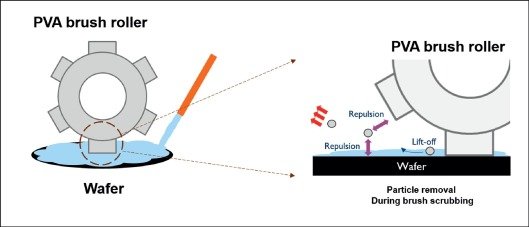
Chemical etching leaves residual salts, metal ions, and chemical sludge on the copper surface. PVA brush rollers physically scrub the panel surface while delivering continuous Deionized (DI) water rinsing, preventing chemical staining before solder mask application.
C. Pre-Lamination Surface Preparation
Particulate matter larger than 5 μm trapped under dry-film photoresist causes opens, shorts, or pitting during circuit pattern etching. High-density PVA brush rollers serve as final inline mechanical scrubbers to verify a clean copper substrate before hot-roll lamination.
Receiving, Preparation, and Installation SOP
Release a new roller for installation only after its identity and condition match the approved purchase specification.
- Verify the shipment. Check the part number, drawing revision, batch identification, packaging condition, and supplied storage instructions. Record discrepancies before opening or installing the product.
- Inspect the roller. Examine the accessible working surface, ends, core, and bond for visible contamination or damage. Use the agreed incoming-inspection method. Segregate questionable material for review.
- Prepare according to the product instructions. Follow the specified wetting, rinsing, or conditioning sequence. Confirm any packaging liquid and its removal requirements. Record the preparation conditions and completion criterion.
- Install using the equipment procedure. Apply the site’s approved equipment-isolation procedure before accessing moving components. Confirm mounting, seating, alignment, clearances, and rotation direction where specified. Use approved handling methods that protect the working surface.
- Complete the installation check. Record the installed roller identification, technician, date, and verified setup. Resolve abnormalities before startup.
Step-by-Step Operating Procedure
Use this procedure as a framework for your PCB cleaning line. Conditioning requirements, contact settings, roller speed, and liquid conditions must follow the approved instructions for the specific PVA brush roller and equipment.
1. Verify the roller and application.
Confirm the part number, dimensions, material grade, and intended cleaning task. Inspect the roller for visible damage or contamination before installation.
2. Prepare the roller.
Follow the supplier’s specified wetting, rinsing, or conditioning procedure. Do not assume a universal soaking time or temperature. Confirm that the roller has reached its required operating condition.
3. Inspect and isolate the equipment.
Follow the machine’s energy-isolation procedure before installation. Check the shaft, mounting components, supports, liquid supply, and drainage paths. Remove contamination using approved methods.
4. Install and check alignment.
Mount the roller without forcing or damaging the sponge. Confirm its orientation, fastening, and clearance using the equipment instructions. Check that the installation supports consistent contact across the intended working width.
5. Apply the approved settings.
Select the validated recipe for the roller and board type. Verify contact adjustment, rotational speed, conveyor speed, and cleaning-liquid conditions. Avoid increasing contact pressure simply to compensate for poor cleaning.
6. Run representative test panels.
Inspect cleaning results and check for surface marks or other unacceptable changes. Evaluate water removal separately if it is part of the process. Release production only after the startup criteria are met.
7. Monitor and record production.
Record the roller identification, settings, and inspection results. If defects appear, preserve the operating conditions for investigation and follow the defined stop criteria.
8. Clean, inspect, and store after use.
Follow the approved shutdown and maintenance procedure. Identify the roller as ready for reuse, awaiting inspection, or removed from service. Use storage conditions specified for its material grade.
Qualification and Production Release
Qualification should show that the candidate roller meets the process requirement across its proposed operating range. A successful startup check supports immediate readiness; it does not establish long-term performance.
Establish a baseline with the current approved process. Document incoming board condition, board construction, existing defects, operating settings, and inspection methods. Compare the candidate using representative panels and controlled conditions.
Evaluate each relevant outcome separately:
- Contamination: Inspect or analyze the target residue using the agreed method.
- Surface integrity: Compare incoming and outgoing surfaces for unacceptable marks or changes.
- Liquid removal: For an absorbent station, assess residual water at defined panel locations.
- Consistency: Include representative board configurations and restart conditions in the trial plan.
Set the sampling plan and acceptance limits before evaluating results. Visual inspection may address visible particles or marks; a requirement for chemical residues needs an appropriate analytical method.
Maintenance, Troubleshooting, and Shutdown
Maintain the roller against observed condition and process performance. Use supplier guidance to establish an initial inspection schedule, then refine it with operating records.
Track installation date, batch, exposure, panel throughput where practical, cleaning history, and removal reason. Record the specific symptom that prompted maintenance.
| Symptom | Investigation priorities | Verification action |
|---|---|---|
| Persistent particles | Incoming load, liquid delivery, filtration, brush condition | Compare defined upstream and downstream inspection areas |
| Water streaks | Alignment, contact uniformity, drainage, roller condition | Map streak positions and repeat the check after correction |
| Repeated surface marks | Debris, working surface, runout, nearby contact components | Compare mark locations with possible contact sources |
| Poor performance after shutdown | Storage state, preparation, restart settings | Repeat the approved preparation and startup checks |
FAQ
Can one PVA brush roller replace every PCB cleaning roller?
No. Confirm the station’s task, mechanical arrangement, chemistry, board range, and acceptance requirements. Qualify a proposed substitution before releasing it for production.
What speed and contact setting should operators use?
Use the equipment and roller suppliers’ approved starting conditions, then establish the production range through trials. Record the setting method and units so another technician can reproduce it.
Is a PVA brush roller the same as a PVA sponge roller?
The terms overlap. “roller sponge” describes the porous construction, while “brush roller” often emphasizes contact cleaning or a shaped working surface. Confirm the drawing, material grade, and intended function rather than relying on the name.
When should the roller be replaced?
Use inspection findings, process acceptance results, and operating history. Set a review interval, but also define condition-based triggers such as damage, compromised bonding, or persistent failure after approved cleaning.
 Spanish
 English
 German
 French
 Vietnamese
 Russian