
1. What Does a Nylon Brush Roller Do in a PCB Wet Processing Line?
A Nylon Roller Brush uses flexible filaments to loosen removable particles while process liquid carries them away. In this article, the term refers to unfilled nylon bristles without embedded abrasive grains. A PCB Cleaning Brush Roller should therefore be specified by its filament construction, dimensions, and intended cleaning task—not by its name alone.
- Particle removal: Bristle contact can help dislodge accessible loose contamination.
- Liquid-assisted cleaning: Adequate flow is needed to transport debris away and limit redeposition.
- Controlled contact: Cleaning performance depends on filament diameter, free bristle length, density, and engagement.
- Defined limits: “Non-abrasive” describes the filament construction; it does not guarantee zero scratching or zero surface damage.
Before adding a roller to a PCB Wet Processing Line, identify what is being removed: dissolved chemistry, loose particles, incompletely developed resist, or stripped resist fragments. These require different corrective actions.
2.Different Post-Etching PCB Cleaning vs. Post-Developing PCB Rinsing
| Process stage | What needs to come off the panel? | Where a PCB cleaning brush roller fits |
|---|---|---|
| After etching | Liquid etchant carried over from the etch chamber and any loose particles on the board | Use the specified rinse sequence for etchant residue removal. If loose particles remain after rinsing, evaluate a non-abrasive brush in a station designed for wet brushing. |
| After developing | Residual developer and loosened photoresist debris, while the developed image stays intact | Start with the spray rinse specified for the resist. If loose debris persists after the developer and rinse settings have been checked, consider brush contact only if it can be qualified on the actual panel. |
| After the final rinse | Water carried forward toward the dryer or next module | If the machine has a dewatering station, use the specified sponge or squeeze roller to remove surface water. |
3. Post-Etching PCB Cleaning: Identify What Remains on the Board
Post-Etching PCB Cleaning starts with the actual process sequence. In a typical inner-layer develop–etch–strip process, the protective resist remains during etching and is removed afterward. Outer-layer processes can use different arrangements and protective layers, so the cleaning method cannot be selected from “post-etching” alone.
| Board Condition | Main Cleaning Objective | Implication for Brush Selection |
|---|---|---|
| Immediately after etching, resist still present | Remove chemical carryover while preserving the protected pattern | Establish rinse performance first; do not assume brushing is acceptable |
| After resist stripping | Remove detached resist fragments and residual process liquid | Evaluate a dedicated cleaning module if approved for the board |
| Bare patterned copper with loose particles | Remove particles without unacceptable conductor damage | Trial controlled contact and inspect fine features |
| Remaining unwanted copper between conductors | Investigate incomplete etching or another upstream defect | Do not treat a cleaning brush as an etching correction tool |
Etchant Residue Removal Depends on Rinsing
Etchant Residue Removal requires adequate liquid exchange and control of chemical carryover. A nylon brush may assist with loose solids in a qualified module, but it does not neutralize the etchant or remove dissolved contaminants independently.
Check the following before increasing brush contact:
- Spray coverage, nozzle condition, and rinse flow.
- Carryover from the preceding chamber.
- Drainage and contamination of recirculated liquid.
- Whether the observed residue is soluble chemistry, solid debris, or an etching defect.
A brighter-looking surface is not sufficient evidence of chemical cleanliness.
4. Post-Developing PCB Rinsing: Protect the Remaining Resist
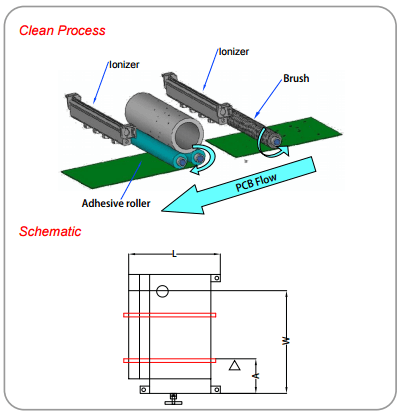
Post-Developing PCB Rinsing must remove active developer and unwanted material while preserving the resist features that remain. Rinsing conditions—including water quality—must follow the specific resist supplier’s instructions.
When Should Brushing Be Considered?
Consider a brush only when the equipment and resist suppliers permit mechanical contact and trials confirm that it does not damage the pattern.
- Identify the resist type and whether it is dry-film or solder-mask development.
- Verify development conditions before introducing mechanical cleaning.
- Inspect line edges, narrow features, openings, and any tented structures after trials.
- Compare downstream results with a rinse-only baseline.
Photoresist Debris Scrubbing Is Not the Same as Development
The phrase Photoresist Debris Scrubbing can describe different tasks. Loose fragments after stripping are different from residual film in areas that should have cleared during development.
5. Selecting Filaments for Non-Abrasive Board Scrubbing
For Non-Abrasive Board Scrubbing, specify the physical brush construction and wet-condition behavior. “Soft,” “pure nylon,” and “chemical-resistant” are not complete engineering specifications.
| Specification | What to Request | Why It Matters |
|---|---|---|
| Non-Abrasive / Pure Nylon | Nylon grade and confirmation that no abrasive grains are embedded | Avoids confusion with abrasive-filled filaments; “pure” alone is not a material certificate |
| Medium Stiffness / Low Stiffness | Filament dimensions and a defined basis for comparison | Supplier descriptions may not represent equivalent contact behavior |
| Filament Diameter | Nominal diameter and tolerance | Influences bending resistance together with material and bristle length |
| Free bristle length | Distance from the supporting structure to the tip | Affects flexibility and contact under compression |
| Spiral Wound / High Tuft Density | Winding pitch or tuft arrangement, fill density, and retention details | Influences contact distribution, liquid access, and debris clearance |
| Acid & Alkali Resistance | Compatibility for the actual solution, concentration, temperature, and exposure time | A broad resistance claim does not establish suitability for every PCB bath |
6. Matching the Brush to the Machine and Process Module
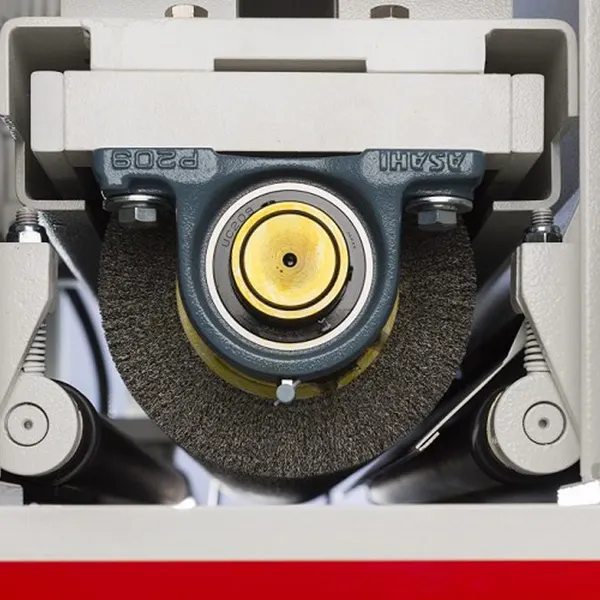
A Horizontal PCB Cleaning Machine must support the panel while maintaining stable contact across the working width. Brush diameter alone is not enough to establish replacement compatibility.
Mechanical and operating checks
- Dimensions: Outer diameter, working width, overall length, bore or shaft ends, and mounting details.
- Panel handling: Minimum board thickness, panel size, support spacing, and resistance to deflection.
- Motion: Rotation direction, permitted speed, conveyor speed, and adjustment method.
- Liquid delivery: Uniform flow, debris removal, and prevention of cross-contamination.
- Wear adjustment: Permitted engagement and minimum usable brush diameter.
Inner Layer / Outer Layer Line
Identify the exact station on the Inner Layer / Outer Layer Line, the layers present on the panel, and the next process. A brush qualified for one cleaning station should not automatically be transferred to another.
Rigid PCB & HDI Manufacturing
For Rigid PCB & HDI Manufacturing, trial panels should include the smallest relevant features and the thinnest supported construction. A rigid panel can still contain delicate resist features or fine copper conductors.
Desmear & Rinsing Module
A Desmear & Rinsing Module serves a different purpose from post-etch or post-develop cleaning. A surface nylon brush is not a substitute for the specified chemical or plasma desmear process inside drilled holes. Any use in an associated rinse stage requires separate equipment and chemistry approval.
7. Nylon Brushes, PVA Rollers, and Other Wet-Process Consumables
Cleaning and water removal are separate functions. Selecting related PCB wet process consumables requires identifying which function each roller performs.
| Product | Function to Evaluate | Selection Limit |
|---|---|---|
| Nylon brush roller | Bristle-assisted removal of accessible loose contamination | Requires qualified contact settings and adequate rinsing |
| PCB PVA brush roller | Wet contact cleaning with a suitable PVA surface structure | Do not assume suitability for developed resist or every PCB finish |
| PP sponge roller for PCB cleaning | Application must be established from the supplier’s construction data | Confirm whether “PP” describes the core or the sponge material, and verify absorption and wettability |
8. Trial Procedure and Acceptance Criteria
Approve a brush through a controlled comparison, not visual appearance alone. Use a rinse-only baseline where practical, and process representative panels with the proposed brush under recorded conditions.
- Define the target: Identify the residue and the measurable improvement required.
- Record the setup: Brush specification, conditioning, chemistry, temperature, speed, and contact.
- Begin within approved limits: Do not transfer settings from an abrasive scrubber or a different board construction.
- Inspect the full panel: Compare edges, center, and representative fine features.
- Check downstream performance: Confirm that cleaning has not introduced defects in the next operation.
Suggested acceptance checks
- Reduction in the targeted particles or residue.
- No unacceptable scratching, resist lifting, or feature deformation.
- No unacceptable change in conductor dimensions or copper thickness.
- Consistent cleaning across the working width.
- Compliance with the process-specific residual-contamination criteria.
If defects appear, review contact, alignment, trapped debris, liquid delivery, and upstream processing before increasing pressure.
8. FAQ Nylon Brush Roller
Can a nylon brush roller remove etchant residue without rinsing?
No. A brush may loosen solids, but chemical carryover requires the specified rinsing process. Brushing alone does not establish chemical cleanliness.
Is a low-stiffness nylon brush safe after developing?
Low stiffness alone does not prove suitability. Contact geometry, engagement, resist condition, and panel support also matter. Use it only after the process is approved and validated.
Can the same roller clean post-etch and post-develop panels?
Do not assume it can. The remaining layers, contamination, and damage limits differ. Dedicated rollers or separately qualified procedures may be necessary to control cross-contamination.
Can a sponge roller replace the post-etch rinse?
Keep the rinse sequence specified for the etchant and equipment. A dewatering roller at the rinse exit removes surface water before the next stage.
Is nylon brush for horizontal PCB line suitable for both inner layer and outer layer cleaning?
Yes. Non-abrasive PA66 nylon brush rollers work for inner layer and outer layer post-etching & post-developing cleaning. Adjust stiffness according to your copper foil thickness.
 Spanish
 English
 German
 French
 Vietnamese
 Russian